

Cleantech Archives

Subscribe to the Cleantech RSS feed.

An Insider’s look at UK innovation in cleantech / greentech & sustainability

The UK’s sustainable energy program is a public-private partnership at work.  And thus far, working well.

I recently had the opportunity to participate in what has become an annual “Cleantech Trade Mission” of Boston and New York cleantechers to the United Kingdom.    Our hosts?  The UK Trade & Investment team based here in the Northeast, part of the large mandate of the British Consulate  here in the U.S. to continue to put planks in the bridge between our two countries, especially when it comes to cleantech and sustainable energy solutions.

Although I joined midweek as was over there for a European-based executive search we were interviewing on, the group moved from North to South, starting on Monday up in Edinburgh, Scotland, then down through Newcastle, Cambridge, and ending with two days in London.

It was a comprehensive gathering of the UK cleantech ecosystem for an exchange of ideas and “show-and-tell” around the UK of their commitment to sustainability and cleantech thought leadership.   Our US band of cleantech brethren among others included investors from Rockport Capital and Kleiner Perkins.

There were  three notable differences between the UK and US surrounding renewable energy & cleantech:

1) Government superstructure like the Carbon Trust (keep in mind, the UK has cap-and-trade and the U.S. doesn’t) Cap & trade drives a true dynamic market in the UK while the US version is still mired in politics on Capitol Hill.  The UK succeeded in passing sweeping energy-related legislation in 2008 (http://www.carbontrust.co.uk/about-carbon-trust/pages/default.aspx ), and the result has been a fueling of the entrepreneurial engine in Britain to come up with new technologies, sciences, and Internet-driven efficiency and monitoring solutions to help drive adoption and integration of the new laws.

2) Landfills and methane is another interesting difference again brought about by the UK’s progressive legislation.  Britain is an island, and a small one at that compared to the U.S. (60+ million citizens, one fifth the size of the U.S.)   There is limited real estate for landfills, and one of the big offenders from landfill is methane gas.  A host of science-driven entrepreneurs have tackled what is referred to as anaerobic digesters (http://www.foe.co.uk/resource/briefings/anaerobic_digestion.pdf )

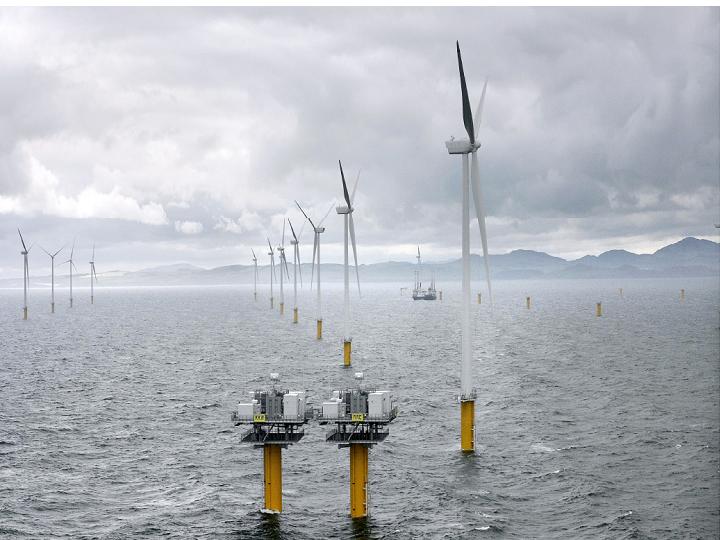
3) Massive investment in offshore wind generation capacity is the third area. It was truly remarkable the detail behind Britain’s likely ascendance to global leadership in offshore wind generation.   Historically, Scandinavia has held that claim.  However, with Britain’s aggressive 2020 goals, they’re going to no doubt lead in offshore wind expertise and GW installed base.

Some quick numbers related to the 2020 initiative:

* Capital expenditures:  £14 billion already spent in the last 5  years.

* £5.6 billion more in cap-ex planned for the next 5 years (keep in mind, this is a country with a population of ~ 62 million, about one fifth the size of the United States)

* Closure of 25% of traditional power stations (coal or other non-renewable sources)

* 25% of natural gas generated from UK sources

* Addition of 44GW of offshore wind power at distances up to 200km from shore, and in water depths down to 80m

Something like 40% of energy capacity is going to be wind, with a vast majority of that coming from offshore wind.  However, UK power generators like NationalGrid recognize that there needs to be a large redundancy due to the intermittent nature of wind as a resource.  NationalGrid is planning primary failover in the form of LNG and CCS capacity to power conventional generation, replacing virtually 100% of existing coal-fired plants with carbon-capture versions.  The best hope to reduce this reliance on traditional energy sources is to innovate a wind power storage solution that can be commercialized between now and the completion of the 2020 UK offshore wind initiative.

Britain is pioneering a number of other innovations, including a CO2 transportation network that transports CO2 for storage (think CO2 “pipeline”), taking a chunk of  the industrial complex’s CO2 emissions and capturing, storing and or repurposing it.

After all that cleantech knowledge transfer, what did the UK serve for dessert?  A cocktail party with London-based cleantech entrepreneurs and investors at Taylor Wessing’s offices on the top floor wrap-around patio on a gorgeous London summer evening (below was the mis en scene).

In addition, we had an opportunity to take a sneak peek from “The View, ”  an official viewing site of the 2012 Summer Olympic Park, at the top of an adjacent apartment building in East London that has impressively grown from a former area challenged by urban decay.   And the London Olympics stand to be the greenest one yet from what we were told, with prolific and cool sustainable innovation even built right into the very steps of the stadiums that use spectator energy expended in climbing up and down the stadium to power an LED lighting system.  One of their sustainability goals is to try to construct the Olympic venue with a net-zero carbon footprint.

Footnote:  Rob Dietel, Vice Consul, who heads the cleantech vertical for the British Consulate’s UK Trade & Investment New England office, is a terrific resource along with his colleague, Kevin McCarthy, also out of the Boston office.  Rebecca Lewis is  Rob’s New York-region counterpart. All three are bringing a select group of UK cleantech entrepreneurs to Boston and New York this Fall.  In addition, they’re planning on putting on a one-day “master class” of sorts showcasing UK offshore wind expertise here in the U.S.  Invitation-only, and for those who are lucky enough to get the invite, it should prove to be great content.  For more detail, Rob is at rob.dietel@fco.gov.uk.

2009 Green Tie Gala Brings Together Cleantech Community at JFK Library

senator-markey-speech-necec-green-tie-gala-2009

Senator Markey addresses the formal-wear only crowd at the JFK Library during Clean Energy Week in November.

An annual event in Boston punches up the fact that we have an incredible cleantech cluster-New England Clean Energy Council’s annual Green Tie Gala.

Although this event took place back during Clean Energy Week in November, I was reminded of it when out in Denver recently.  Denver has some great stuff going for it.  NREL (National Renewable Energy Lab), University of Colorado with multiple campuses in Denver and Boulder that have significant funding from both Federal and State agencies, and a history of technology oriented companies, albeit with a heavy emphasis on telecom (Qwest, Level 3).

However, what there isn’t as much of in Denver is what some call the “ecosystem.” Others call it the “cluster.” This is a body of people who hold different but overlapping responsibilities in the entrepreneurial ecosystem and whose fusion is its wellspring–

  • Academics: These are those most often with the new disruptive technology or science breakthrough that serves as the seed of a new company
  • Business entrepreneurs: those who have experience taking the seed of an idea, and building a company around it
  • Investors: The first friends & family, then angel investors, and often venture capitalists or corporate strategic investors who pour money into these new ideas to fund the business entrepreneurs scale the disruptive idea
  • Professional services providers: These are often the “connectors” in the ecosystem. They’re comprised of lawyers, accountants, executive search consultants, and start-up advisors. They act as the glue between the prior three categories, more often than not introducing one to another, supporting the growth of these companies with their area of specialty

[Footnote: If you compare Boston to Silicon Valley however, Boston is shallower in large technology and sciences companies that serve to spawn "runners" to new start-up companies.   The biotech industry is perhaps better in Boston at doing this than the pure technology industry in the last decade, with a growing base of larger biotech and pharma companies including Genzyme, Cubist, Biogen and Sepracor.  Medical devices companies also fair better in many ways to large tech, with Boston Scientific, ThermoFisher, and Perkin Elmer.  In technology hardware and software, beyond EMC, there are precious few large technology companies left in Massachusetts. ]

Details on the Gala?  This year’s Green Tie Gala was held at the JFK Memorial Library in Boston (last year was held at the Museum of Science).    There are many organizations in the innovation sector here in Massachusetts that have done a good job at galvanizing a broad cross section of constituents, including the Mass Biotech Council, as well as MITX (formerly MIMC), and the Massachusetts Technology Leadership Council, or TiE Boston (Indus Entrepreneurs).  However, we’ve had yet to participate in a gathering of any that approaches that of the cleantech cluster here in New England.

Senator Markey gave the opening address to punctuate the cocktail hour.  To a person it seemed, everyone knew everyone.  Yes there were a few outsiders (a small contingent from the UK had come over as part of a trade mission coordinated with Clean Energy Week in Massachusetts because of its target rich calendar), yet all of these were welcomed by the larger fold, and the gathering seemed to virtually breathe together as some sort of larger unified body, a cluster with so few degrees of separation that walking from group to group or table to table was akin to going back to your high school reunion…. You knew at least half those sitting at every table.  For those who have experienced the annual Nantucket Conference, it is this atmosphere if intimacy and familiarity that presides.

To cap the night off, venture capitalist Chuck McDermott of Rockport Capital led his band in an after-hours session that continued the beat of familiarity both given its leader as well as in its musical selection (Chuck stating that the band only plays “songs popularized before 1960″).

chuck-mcdermott-and-band-green-tie-gala-2009

Chuck McDermott, leading cleantech venture capitalist at Rockport, moonlighting as 50's music band leader


Experts Brainstorm with DOE on IP Commercialization Improvements in salon setting in Boston

istock_000007845651xsmallistock_000005846970xsmall1

A weekday morning in late November.  A brownstone residence on Beacon Hill in the shadow of the State House.  A dozen of the foremost experts in technology transfer and intellectual property in the Boston innovation cluster.  And a representative from the Department of Energy.  We at BSG Team Ventures had the recent opportunity to host a salon-style meeting in a home of a friend of the firm during Clean Energy Week here in the Commonwealth (for more on Clean Energy week, see http://greenovationconference.com/conference-info/cew.html).

The purpose?  Bringing the best minds in the Boston venture, entrepreneurship and innovation community together for a brainstorming session with the Department of Energy around best practices in technology transfer out of our national laboratories.   Attending the meeting were Alan Gordon from Harvard University Technology Licensing Office, Chris Noble from MIT’s TLO, head of the Mintz Levin cleantech practice Tom Burton, Peter Rothstein from the New England Clean Energy Council, Director of the Massachusetts Technology Transfer Center Abi Barrow, Director of Partners CIMIT John Collins, General Partner at Flagship Ventures Jim Matheson, and CEOs Chris Hobson and Peter Vandermeulen each running cleantech start ups with technology licensed out of several of the national labs themselves.

The challenge the current Obama Administration is taking on under Secretary of Energy Chu is how to better mine the metaphorical gold created inside the U.S. Department of Energy-funded  national laboratory network of some 15 that are spread across the country.  Some of these labs are household names–Los Alamos and  Sandia (New Mexico), and Lawrence Livermore (California).  Others are less well known-Argonne (Illinois), Brookhaven (NY), and Ames (Iowa).  Even the National Renewable energy Lab (Colorado, known more often as NREL), are not as well known as one would hope.  The history of these national labs springs from energy research spurred by World War II.  What the layperson may remember is that many of these labs were where secretive nuclear energy research was conducted.  However, much of the mandate for these labs some 60 years later is focused on discoveries that will broadly contribute to advancing the United States’ understanding of energy, renewable energy, energy conservation, and all the various scientific disciplines that can contribute-physics, materials engineering, chemistry, and more.  These labs are panning for a 21st century gold-energy discoveries and breakthroughs that will create new batteries using renewable resources, wean the U.S. dependence on oil and coal as primary energy sources, and break new barriers in energy efficiency.

However, the problem has been that these labs have explored a lot, and engaged in extensive primary research, but have punched below their weight class in bringing innovation from discovery through to successful commercialization.  The DOE budget in FY 2009 topped $25 billion.  The national labs budget made up approximately $10 billion of that.  And with the Obama administration’s  stimulus package, these numbers only look to be increasing.  One example brought up in the conversation to punctuate the problem from one of the Boston-based attendees was that fact that Argonne National Laboratory in the last decade has created less than a dozen successful out licensing/royalty events that generated meaningful returns.   Logic holds that in terms of return-on-investment, there remains much room for added improvement.

So, two hours later, what were the issues that were brought up by the braintrust, and potential solutions that were tendered to improve the return on investment the DOE makes in the national laboratory’s innovation mission?

Some of the key issues with the current structure that came out of the dialogue:

•    Risk aversion of national labs researchers to leave the security of the lab to spearhead a risk-laden venture

•    Innate interest of lab researchers is more geared toward research and “discovery” versus market-matching and commercialization

•    Low/no financial incentive to take a discovery beyond research phase

•    No business ecosystem or business-savvy catalysts to help focus lab research talent on “known problems,” or the sifting through lab breakthroughs to match-make with existing  business  problems

Suggestions for improvement focused around the three ingredients that are key to metaphorical “combustion” of the innovation commercialization engine: More…

Good showing at NREL Growth Forum’s 22nd Conference in Denver

I had the opportunity to be out in Denver for the 22nd Annual National Renewable Energy Lab’s (NREL) Growth Forum.  As many know, the U.S. has more than half a dozen national labs, some of the best known being Los Alamos and Lawrence Livermore, and Sandia.  These labs are scattered across the U.S., and each often has a specific focus (nuclear research for instance is what has kept the National Labs in the public eye most often).

Given the Obama Administration’s commitment to renewable energy and innovation, it was an upbeat gathering.    The attendee list was well-balanced between entrepreneurs, venture capitalists, and academics.  Geographically, the majority of attendees either hailed from the Colorado area (with Boulder as the epicenter for cleantech in CO despite the NREL lab being located in Golden, CO), the West Coast (Silicon Valley entrepreneurs and venture investors), and New England (Boston-skewed).

What was surprising is how small the renewable energy community truly is.  It’s still a very close knit group.  And the community tends to shift from one location to another to pursue the next opportunity to contribute to the national cleantech ecosystem.  Two notable examples are Tod Perry, who now is the Program Manager of the Clean Energy Entrepreneurship Center for NREL.  Tod had originally started as a cleantech entrepreneur 5 years ago in Boston, pioneering a water purification technology, and a contestant in the first Ignite Clean Energy Competition in 2005.  Another Bostonian who’s moved out to Colorado recently is Trent Yang, formerly a principal at Globespan Venture Partners, now Director, Entrepreneurship and Business Development at RASEI in Boulder (Renewable and Sustainable energy institute), part of the University of Colorado commitment to innovation in the renewable energy sector in the Rocky Mountain region.  Other notable Bostonians sited at the conference included Peter Rothstein of New England Clean Energy Council, Bob Metcalfe of Polaris, and Chris Hobson, CEO of BandGap Engineering.

While out there, stopped by the Finals for the Cleantech Open’s Rocky Mountain Finals.  New Sky Energy, Rivertop Renewables, and SunTrac Solar were the winners, now headed to the Cleantech Open Finals for all 3 regions up in Silicon Valley.

For more on the winners, see http://www.metrodenver.org/news-center/metro-denver-news/mayor-hickenlooper-announces-cleantech-open-winners.html

CEO Equity Compensation Calculator

carrot-and-stick, CEO Compensation

We’re often asked how to establish fair market compensation when it comes to CEOs of privately held companies, often with venture capital or private equity backing.

Below is one method that can be employed as a jumping off point for this calculus:

1)     “De-risked,” how much is a CEO worth?  Is  $500 -$1M a year too much?  For our purposes here, we’re talking about a talented CEO.  Not someone below average, but above the average, one that a retained executive search firm, venture or private equity investor, or board of directors would be proud to put in the role.   Rather than pick some arbitrary number, this should be  ”market set,” by looking at what someone working for any global 2000 company (i.e. General Electric or other similar) earns annually.  From our executive search experience and database of compensation comparables in these companies, base salary is usually between 250K and 400K, depending upon how big the divisional P&L responsibility is, there is usually a bonus that is between 50-100% of base, and an LTIP (long term incentive plan) that-once partial vesting begins-can generate from 100K up to 250K or more a year in cash.

2)     So, the cash component of a comparable, including average base, annual average bonus, and yearly LTIP pay-out looks something like this:

Base ~ 300K

Bonus ~250K

LTIP (cash only) ~ 200K

TOTAL: 750K

* This does not include any meaningful RSUs (restricted stock units) that are usually also part of that package, which could add another 200K or more per year in value to a general manager’s package with true P&L responsibility for their division, group, or sector/segment.

* This is also not indexed to geography/cost of living.  If the position is in New York City tri-state area (New York, northern New Jersey, southern Connecticut), San Francisco, Boston, London, Singapore, Hong Kong, or Tokyo, a multiplier factor needs to be used to level-set for cost of living increase required for those metropolitan areas.

3)      Now, back out the cash portion of a CEO’s compensation for the company that they’re stepping into (say 250K a year in cash in smaller companies as all base, or combination of base + cash bonus).  So you’re left with say 500K that needs to be made up in equity, on a per anum basis.

4)      Over how many years is the liquidity horizon (and/or vesting rate, 3, 4 ,5 years)? Let’s say it’s 4 years, at net 500K, equals ~$2 million

5)      Now, this is with ZERO beta risk factor.  Add back the beta risk of an earlier stage company.  Let’s assume a global 200 company equals “1.”  A CEO role in a privately held, externally backed company is not “1″.  It’s probably a multiplier of 1.5, or 2.  For a pre-revenue, VC-backed company with high burn rate, it could be as much as in the 3 to 5 range.  Note that any illiquid company is inherently risky in terms of cashing in any equity at a reasonable price.  Let’s pick a beta risk multiplier of 2.5 times riskier than “average.” So, 2M * 2.5 = 5M.  Note that when there are preferences for the investors that create an exit hurdle rate before any common shareholders get paid, beta risk goes up accordingly unless the CEO participates in any exit event via cash carve out or other instrument.   As mentioned above, a recent IPO that represents a reasonable market comparable netted a CEO who joined the company 4 years ago $20M.  Using this number, the CEO’s compensation was $5M a year, or a beta multiplier of approximately 5.

6)     Then, are there any combat pay provisions you need to add in (warts that a CEO or executive team member is required to overcome and vanquish in their role that are above and beyond the normal call of duty)-reconstituting the executive team, or raising an outside round of capital because existing investors are tapped out, or starting up an Asia manufacturing capability that will require the CEO to take a dozen 15-hour flights one-way to get up and running.

7)      Finally, you have to look at what likely dilution there is going to be to an initial options grant for the CEO.  If you start with a 6% stake in an early stage company in a Series A funding, and you then raise a series B and C, depending upon valuation for those rounds, the CEO will likely end up below 3% as a “fully diluted” stakeholder.  There is an argument to be made that any of the management team critical to the success of the company will be “topped off” at later funding events in order to keep them motivated.  However, there is no guarantee that this happens.  It’s only good business sense to do it.  For the CEO, it is more important what s/he ends up with, not how much with which they start.

8)     Add water, and stir…

Notes & disclaimers:

  • * This is not intended to be biased in any direction, to any party, neither CEO candidate, nor company and/or investor.
  • * This is only one way of calculating compensation, indeed there are many others.
  • * There is no way an earl- stage emerging/growth company will be able to compensate a CEO in all cash, nor truly be able to offset the risks inherent in this stage of venture.  The CEO either accepts this, or is not truly capable of working successfully in this milieu.
  • * Other than the impact of cost of living  adjustments to base compensation, each CEO candidate comes with what we refer to as their own subjective “keep the lights on” cash needs.  We calculate this simply as the amount of cash required on a yearly basis to cover their living/family obligations without having to write checks out of savings to cover it.  Some CEO candidates may have 3 children in private school or college, while others may have no children and no mortgage.  Cash needs therefore may range widely, and need to be adjusted for using equity as a “leveler” (less cash-needy, higher the equity, and vice versa)
  • * Alternatives to paying bonuses in cash might be to pay bonuses in equity, upon achievement of key milestones for the company
  • * This same calculus can be applied to the Vice President level as well, subject to appropriate adjustments downward in cash and equity
  • * In a circumstance where there is a “turn-around” required, equity may not be enough of a certainly to attract a competent CEO for the challenge ahead.  In these circumstances, a cash carve-out may be warranted in addition and/or in substitution for a stakeholder role.  The cash carve-out may be just for the CEO, or for the key management team required to achieve the turn-around.  Often, the cash-carve out structure is a percentage of total sale price over a certain amount, with the possibility for an accelerator depending upon exit/liquidity circumstances/outcome.
  • * Often the question of anti-dilution comes up in an effort to assure a CEO of a certain percentage of equity upon liquidity.  Granting 5% equity to a CEO at a Series A financing with anti-dilution would ensure that the CEO retained his or her stake across the growth and additional funding needs of the company.  However, this is rarely a good mechanism, as the CEO becomes less interested in new company valuations at subsequent funding events, and becomes misaligned with the company’s investors.

Headhunting Goes Global When Considering Talent for Innovation-driven Companies

I had Tuesday to Monday eve in mid-September in a race across the planet to take advantage of British Airways’ generous offer to fly a batch of entrepreneurs wherever they wanted to go in an effort to further each’s fast-growing businesses… at no cost.

My itinerary?  Starting from home base of Boston, then to New York’s JFK, through London, with the ultimate destination– Singapore.  Total air time one way? 18 hours.  Total air and waiting in airport time one way? 24 hours.

What earned me the opportunity?  First, membership in the Entrepreneurs’ Organization (“EO,” www.eonetwork.org, formerly known as YEO, or Young Entrepreneurs’ Organization ) a global membership organization that is nearing 10,000 members across more than a 100 chapters.  EO is one of a group of leadership organizations, including YPO, WPO, CEO, and several others.  Qualifications for EO membership include annual revenues of $1 million or more, and either founder or majority ownership status in your business.

Hailing from the Boston chapter of 100 or so EO members made up of computer software and hardware entrepreneurs, legal and staffing professional services business owners, and a host of other small business founders  including franchising, travel, consulting, real estate, and medical devices, I was made aware of the strategic partnership between British Airways and the EO organization.  The following paragraph, detailing what a face-to-face opportunity would mean to the growth and expansion of our boutique retained executive search firm, BSG Team Ventures, was what I jotted down–

We have a presence in Boston, New York, Silicon Valley, and London. These are key global innovation centers. However, there is clearly a fifth and/or sixth  location to round out our client value proposition of “on the ground coverage in the key innovation centers in the world”– and those are India and Asia. Although there is a term sometimes used that combines the two (“Chindia”), we feel that there is perhaps a need to be able to service our growth-stage clients in each. One alternative is a meaningful position in a location like Singapore, which is equidistant from both these key innovation markets.

The ability to set up a series of meetings with potential partners, and then bring pre-meeting calls and video conferences to an in-person, face-to-face setting, would be extremely meaningful in taking our business from EU-American only, to truly global, capable of better servicing the needs of our clients who continue to demand the need to themselves expand globally.

I had been to Singapore and Hong Kong in 2008 on business, and knew that another trip there would allow us to cement some developing relationships “face-to-face.”  In 2008, we completed a VP Worldwide Sales search based out of Singapore, and are now working on another General Manager search based out of Tokyo for a leading global technology innovator.  And with the recession of 2008-2009 projected to recover in west-bound fashion this time (Asia first, Europe second, and the U.S. last), China, Japan, and the rest of the Asia-Pacific corridor is important to every business, both large or small like ours.

Having won the right to cash in the BA offer, a plane load of entrepreneurs amassed down at JFK airport in New York.  BA was everything they’ve built their reputation on-service-oriented and courteous, only as the British can be-with a send off in the first-class lounge that was rich in food, spirit(s), networking with other entrepreneurs, and a few humor-filled greetings speeches by both British Airways officials and the British government.   Example of the power-networking in the BA lounge? I met up with Morgen Newman, co-founder of IdeaPaint, another Boston-based start-up that was a BA travel recipient, with a company out of Babson (my alma mater so plugging here) that has formulated a special paint that can be applied on any work surface that then functions as a “whiteboard,” completely erasable when using dry-erase markers.  IdeaPaint is a tool for entrepreneurs that simply brilliant.  Most entrepreneurs are visual thinkers, and this now allows us to scribble on every surface…. (“Beware office cleaners-these walls aren’t “dirty”…. DO NOT ERASE!”)

My itinerary and goals for the trip looked like the following: More…

3rd Quarter 2009 CEO Survey Results– Strategy & Outpacing your Competitors in the Recovery

Strategy for Innovation

Every few months we survey the innovation-stage community of CEOs with the goal of leveraging our C-level relationships as executive recruiters to generate collective wisdom to share back.    We hope below you find insights that help to run your companies more strategically.

In August, we surveyed our CEO community and had more than 60 CEOs participate.  Thanks to all who contributed.   The theme of this survey was centered around whether a different strategy is required to succeed post-recovery than that which was in place pre-recession.  These CEOs came from those practice areas in which we focus, and included broad based technology companies in the media, software, mobile and telecom sectors, Biotechnology, medical devices, and cleantech / renewable energy.

Innovation-stage CEO survey

The 60-plus participating companies were spread across the growth-stage spectrum, ranging from pre-revenue through profitable/shipping product, most being seed-funded through post-Series C, as well as private equity-backed–

Innovation-stage CEO Survey, September, 2009

To set the stage for the survey questions, when asked when CEOs were expecting the recovery to materially reach their companies, the results were still quite bearish, with more than 50% responding Q2 2010 or later–

growth-stage/ VC-backed CEO survey

Although entrepreneurs are supposed to be eternal optimists, when asked what sort of recovery CEOS expected, again, the majority picked the worst of the alternatives, with more than half opting for a “W” recovery (in graphical terms, a double dip, with the last year starting September 2008 to now equalling the first “u” of the “W,” and another anticipated dip between now and Q2 2010 or later.  Almost as bearish, 28% of CEOs chose an “L” recovery, indicating that they felt “recovery” was really better defined as a flatting out of the downward trendline, but no corresponding upward rebound–

growth-stage/ VC-backed CEO survey

The next several survey questions focused on business strategy.  58% of CEOs indicated that they were not planning on pursuing the same strategy after the recession than before–

growth-stage/ VC-backed CEO survey

In executing on their strategies, CEOs responded somewhat intuitively that sales & business development functions would be two of the most important executive level functions that would help them in executing successfully post-recovery.  Somewhat less intuitively, the third most important functional area ranked was product development–

growth-stage/ VC-backed CEO survey

The last strategy question posed to CEOs was whether - if a majority of the CEOs were executing on a different strategy in post-recovery than pre-recession – did CEOs feel that the same executive team they had could execute effectively on both.  More than a third of CEOs surveyed indicated, no, their current executive teams were not the right teams for their new post-recovery strategies.

growth-stage/ VC-backed CEO survey

As for their companies’ financial condition, 60% CEOs responding indicated they were still burning cash, 15% were cash flow break-even, and 25% were running their companies in cash positive position–

Innovation-stage CEO Survey, September 2009

And answering the perennial question as to whether CEOs were planning on raising equity capital in the near future, slightly more than half responded in the affirmative–

Innovation-stage CEO Survey, September, 2009

In conclusion, the survey pointed up the fact that innovation-stage companies are still very cautious around the economic forecast, have recast their strategies as different from pre-recession in preparation for the recovery, but still have some retooling to do within their executive teams to optimize the chances of outstripping their competitors in 2010.

Thanks again to the CEOs who participated.  Knowledge is power.  Collective knowledge is actionable.

CEO compensation Analysis, West vs. East, and Founder vs. Non-founder

carrot-and-stickl

We are often asked to do some executive compensation “ciphering” on behalf of our clients.  Getting an accurate read on market compensation is always a bit of fuzzy math.  You can call around to those you think may know or are in those positions now, you can commission a survey, or dig into some of the executive compensation databases that pre-exist.  We often do all three on behalf of our clients.  However, the below numbers are based on the Dow Jones executive compensation data collected several times a year, targeting venture-capital backed companies in the U.S.  The companies surveyed cover early stage seed-round and Series A, through later funding stages, and companies that are pre-revenue through shipping product and profitable.  From an industry perspective, the below data is an amalgam of all venture-backed industry sectors in the U.S., including technology (software, hardware, services, interactive media, etc.), sciences (biotech specifically), medical devices, cleantech / renewable energy, and other related fundable venture sectors.

For this bit of ciphering, we’ve focused on three executive compensation comparisons involving CEO compensation–

1)     West Coast versus East Coast, and the differences that may exist between them

2)     “Founder CEO” vs “non-founder CEO”

3)     and early stage CEO compensation vs. later stage companies and associated CEO compensation within

This is always an interesting analysis.  Each category of CEO always feels as if the other is getting a “better deal”-CEOs on one coast think it’s likely better on the other, and founders and non-founders often feel the other has a better package.  Similarly, early-stage CEOs are often jealous of the “rich cash packages” that they seem to hear about in later stage companies, and late-stage CEOs always feel that early-stage CEOs get so much more meaningful an equity position than they as “hired guns” seem to be able to garner.

Note that below we’ve only included the analysis of the executive compensation data, in other words the deltas.  If you’d like more detail and the information on which we based the analysis, please email damador@bsgtv.com with your name, title, company and business email address, and we can provide you with the baseline full report.

Do keep in mind that this is only one set of data.  To draw the best comparables, it’s important to do all three data-grabs listed above.  Also, this is a “blended” sample set of all venture-backed industry sectors.  Some industry sub-segments may pay more or less than others with further parsing.

Highlights of the analysis

In the first “delta” table, we took a look at West versus East for early stage start-up/product development focused companies.   What was apparent in this earlier stage company setting was most recently, West Coast early-stage CEOs  on the whole have lower cash packages in both base and bonus. In addition, an equity analysis also returns 1-2% less on the West Coast than East in this data set in the lower quartile and median.  However, in the top quartile compensation range (those CEOs who have compensation in the top 25% of all CEOs surveyed), West Coast CEOs outearned East Coast in both cash (by only $13,000) and equity (a full 1% more).  Another interesting data point is that West Coast CEO’s have more upside in terms of bonuses (an average of 27% of their base compensation) than East Coast CEO’s whose bonuses are an average of 16% of their base compensation.slide11

In later-stage companies where they are already shipping product, West Coast founder CEOs are paid less cash and ultimately hold less equity than East Coast founder-CEOs, except again for the top equity quartile, where West Coast founder-CEOs make up for less cash with +4% more equity on average than East Coast founders.  However,  West Coast bonuses for CEO are 29% of their base compensation while on the East Coast, CEO bonuses are 22% of base compensation.

West Coast non-founder CEOs (hired guns) make more than East Coast in cash only.  Equity is about the same, East vs. West.

On the East Coast in later-stage companies professional president/CEOs are paid less cash and hold less equity vs. similar founder CEOs.

On the West Coast, the pattern that Noam Wasserman at HBS has observed does prove out–  that non-founder CEOs get paid less cash compensation, but hold much more equity than their non-founder CEO counterparts (see http://founderresearch.blogspot.com/)

slide21

Cleantech CEO Poll: Is the carrot of stimulus dollars influencing your strategy?

We’ve begun to circulate weekly questions posed by CEOs of other peer-CEOs in an effort to bridge the knowledge gap.

These questions range from fundraising to economy related,  compensation, board management,  product development,  sales etc.

This week’s question is industry-specific to cleantech, only circulated to CEOs in the broadly defined cleantech segment:

All your responses are anonymous due to the nature of the polling software employed above.   Prior CEOs’ cumulative responses are available immediately after answering the question here. The response will also be forwarded by email within a week of the poll launch.

Ours is a two-part value in this Q&A exercise:

  • validating the respondents as posessing the experience required to answer the question(s) with authority, and
  • retaining the buffer between asker and answerer

Thanks in advance for your input.

CEO Peer Survey, August 2009 — Preparing for Recovery?

istock_000005846970xsmall

Below is the hyperlink to our latest CEO peers “speed-survey,” exclusively for growth-stage CEOs.  Topic– “Preparing for Recovery?”

http://surveys.polldaddy.com/s/D3642F14267CCC14/

We at BSG Team Ventures periodically take the temperature of the markets we serve. This speed survey is no more than 10 questions, simple multiple-choice.

Knowledge is power.  Aggregated peer-provided knowledge is “actionable power.”

We make an effort to survey only those who fit the category (in this case, sitting CEOs or board member/founders of technology/science-driven growth-stage companies). [Note, if you don't fit the aforementioned description, please refrain from responding.]

Feel free to forward to the qualified CEOs in your sphere of influence.  The more data generated, the more accurate the trend lines.

All responses are anonymous due to the web-based survey technology employed.

We will forward the survey results within the next two weeks to the email address on file.  Please let us know if there is another email address you wish us to send the results to as well.

« Older Posts