

global executive talent Archives

Subscribe to the global executive talent RSS feed.

Headhunting Goes Global When Considering Talent for Innovation-driven Companies

I had Tuesday to Monday eve in mid-September in a race across the planet to take advantage of British Airways’ generous offer to fly a batch of entrepreneurs wherever they wanted to go in an effort to further each’s fast-growing businesses… at no cost.

My itinerary?  Starting from home base of Boston, then to New York’s JFK, through London, with the ultimate destination– Singapore.  Total air time one way? 18 hours.  Total air and waiting in airport time one way? 24 hours.

What earned me the opportunity?  First, membership in the Entrepreneurs’ Organization (“EO,” www.eonetwork.org, formerly known as YEO, or Young Entrepreneurs’ Organization ) a global membership organization that is nearing 10,000 members across more than a 100 chapters.  EO is one of a group of leadership organizations, including YPO, WPO, CEO, and several others.  Qualifications for EO membership include annual revenues of $1 million or more, and either founder or majority ownership status in your business.

Hailing from the Boston chapter of 100 or so EO members made up of computer software and hardware entrepreneurs, legal and staffing professional services business owners, and a host of other small business founders  including franchising, travel, consulting, real estate, and medical devices, I was made aware of the strategic partnership between British Airways and the EO organization.  The following paragraph, detailing what a face-to-face opportunity would mean to the growth and expansion of our boutique retained executive search firm, BSG Team Ventures, was what I jotted down–

We have a presence in Boston, New York, Silicon Valley, and London. These are key global innovation centers. However, there is clearly a fifth and/or sixth  location to round out our client value proposition of “on the ground coverage in the key innovation centers in the world”– and those are India and Asia. Although there is a term sometimes used that combines the two (“Chindia”), we feel that there is perhaps a need to be able to service our growth-stage clients in each. One alternative is a meaningful position in a location like Singapore, which is equidistant from both these key innovation markets.

The ability to set up a series of meetings with potential partners, and then bring pre-meeting calls and video conferences to an in-person, face-to-face setting, would be extremely meaningful in taking our business from EU-American only, to truly global, capable of better servicing the needs of our clients who continue to demand the need to themselves expand globally.

I had been to Singapore and Hong Kong in 2008 on business, and knew that another trip there would allow us to cement some developing relationships “face-to-face.”  In 2008, we completed a VP Worldwide Sales search based out of Singapore, and are now working on another General Manager search based out of Tokyo for a leading global technology innovator.  And with the recession of 2008-2009 projected to recover in west-bound fashion this time (Asia first, Europe second, and the U.S. last), China, Japan, and the rest of the Asia-Pacific corridor is important to every business, both large or small like ours.

Having won the right to cash in the BA offer, a plane load of entrepreneurs amassed down at JFK airport in New York.  BA was everything they’ve built their reputation on-service-oriented and courteous, only as the British can be-with a send off in the first-class lounge that was rich in food, spirit(s), networking with other entrepreneurs, and a few humor-filled greetings speeches by both British Airways officials and the British government.   Example of the power-networking in the BA lounge? I met up with Morgen Newman, co-founder of IdeaPaint, another Boston-based start-up that was a BA travel recipient, with a company out of Babson (my alma mater so plugging here) that has formulated a special paint that can be applied on any work surface that then functions as a “whiteboard,” completely erasable when using dry-erase markers.  IdeaPaint is a tool for entrepreneurs that simply brilliant.  Most entrepreneurs are visual thinkers, and this now allows us to scribble on every surface…. (“Beware office cleaners-these walls aren’t “dirty”…. DO NOT ERASE!”)

My itinerary and goals for the trip looked like the following: More…

Vice President of Americas Sales

VP Sales Americas, Commercial Division

The Company

Becoming the leading content provider of geospatial imagery for mapping & monitoring applications

Our client has its roots in rocket science… literally.   Since the first image was collected from space over 30 years ago by classified government imaging systems, only a limited number of people have been permitted access to highly detailed photos of the Earth, and the industry was tightly regulated.  Since its deregulation in the 1990’s, our client is changing this historical usage of Earth information through the commercialization of high-resolution satellite imaging and an innovative approach to conducting business with customers, partners and resellers. The company was founded in 1992 to launch satellites into space for the purpose of taking high-resolution photos of the earth for defense and intelligence, government, and commercial use.   In early 2000, the US government awarded its first significant contract for satellite imagery to the firm.  Currently, the company offers the world’s highest resolution commercial satellite imagery, the largest image size, and the greatest on-board storage capacity of any satellite imagery provider.  In addition, the company’s comprehensive ImageLibrary houses the most up-to-date images available.

In 2004, our client struck an exclusive portal agreement to supply much of its satellite imagery to Google’s new product launch, branded Google Earth.  This deal served as both validation for a broader explicit push as well as anchor tenant into the non-federal government, commercial sector.

The company is headquartered near Boulder, Colorado, with other offices and facilities in key geographies throughout the world.  Commercial division headquarters are in Needham, MA. More…

Collision course between Executive Leadership Succession and Global Demographic Trends in coming Decade

Having just finished an executive search for a General Manager of Asia Pacific and EMEA region where the candidate was located in Singapore, who was born and had early childhood in India, and educated and now a citizen of the U.S., the question of global talent trends comes to mind. Is this typical of the future executive leadership puzzle, where pieces will come from around the globe? Reflecting at year’s end on the coming year, and the fact that we’re almost at 2010, we got to thinking about leadership succession and the next generation of leaders we’re grooming. With all the news of layoffs at all levels in the media, and despite the forecasts of some of the toughest economic times America has seen since the Great Depression, there are some really interesting global macro trends that are worth noting when it comes to executive recruiting, and executive talent management in the next few years. And now is probably a really good time to start the planning around the impacts these demographic prognostications may have.

The quick headline is this– Baby Boomers as we all have heard (approximate age range of 42 to 60), are aging. And Boomers make up the vast majority of executive leadership roles in corporate America. This includes Wall Street AND Main Street businesses, large and small. In fact, there is some evidence that more entrepreneurs starting businesses are boomers than any other age group. Boomers are fully one-third of the US population now (US Census) and X generation (54 million, ~17% of U.S. population), Y generation (aged between 18 and 30, about 75 million, clocking in at ~25% of U.S. population), and Z, AA, etc (who knows) generations are smaller due to lower birthrates post-Word War II. As the nextgen executive pool is a much smaller one (see http://www.thefutureofwork.net/assets/Review_of_Workforce_Crisis.pdf), we have to ask the obvious question– where is leadership going to come from in the next 5 to 25 years? Who will drive the U.S. knowledge economy, and can the U.S. continue to sell itself as the global melting pot, successfully continuing to woo other countries’ best and brightest with our promise of streets paved with gold? Or, given the two busts in the last 8 years, one Internet and the other financial markets, is the next generation of leaders going to reverse the brain drain from rest of world to the U.S. to its opposite? We’ve certainly seen recently emerging global powers like China actively push to woo and re-patriate Chinese who had migrated to the U.S. for higher education and opportunity.

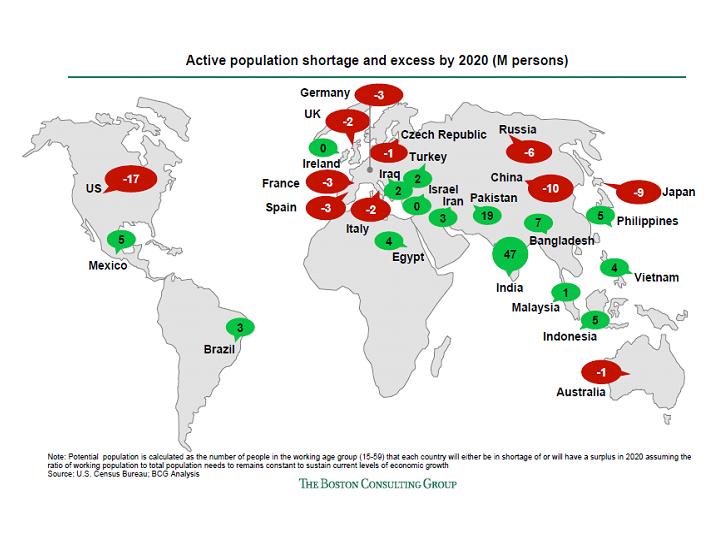
What is counter-intuitive to perhaps many however is the demographic shifts and a snapshot of what the global talent marketplace looks like in 2020, a mere 11 years away. We were recently at the IACPR Annual Conference (International Association for Corporate and Professional Recruitment, www.Iacpr.org ), and had the opportunity to hear one of Boston Consulting Group’s Talent Practice leaders, Rosalinde Torres, address this issue.

For a summary of the Boston Consulting Group report pdf, go to www.bcg.com/publications/files/Creating_People_Advantage_Summary_May_2008.pdf. For the visual, look at the world map graphic above. Red circles are countries with a net loss of eligible leadership population by 2020. Green circles are those countries with a net gain. One might think that China would be a big player in future leadership, but with their one-child policy, they’re down 10 million. The U.S. is down 17 million. The possible winner for building the biggest pool of future leaders is India, up 47 million people. This is almost more than all the rest of those countries with net positive growth combined.

Food for thought as we go about building executive teams for 2009, 10 and deep into the next decade.