
Most of the COO and President searches that land on our desk start the same way: an operating partner calls, describes a CEO who's stretched thin, and asks how fast we can move. The tone is usually some version of urgent. Onboarding has slipped. A key customer relationship is being run out of the CEO's inbox. The board asked about succession at the last meeting and nobody had a good answer.
By the time that call comes in, the company has usually been running hot for a while.
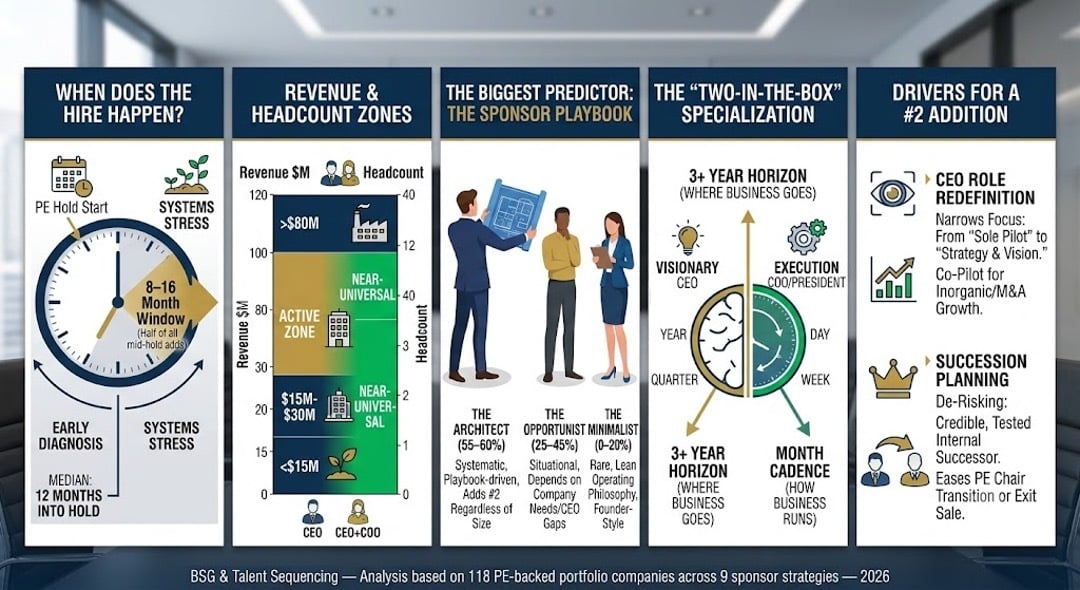
We recently sat down with the data — 118 lower-middle-market portfolio companies, 9 sponsor strategies — to check a suspicion we'd had for years: that the #2 hire is treated as an emergency far more often than it needs to be. The numbers back it up, and they point to something more useful than a warning. They point to a window.
The window is real, and it's earlier than most sponsors act on it
Among the roles added during a hold, half land between 8 and 16 months in — right around the point where a CEO has had two or three quarters to actually diagnose the business. That's not a coincidence. It's roughly the moment a founder-CEO or first-time PE-backed operator has enough information to know what they don't know, and not yet so much operational debt that the search becomes reactive.
Companies at this stage are typically doing something in the neighborhood of $30M in revenue. Not a hard trigger — the data doesn't support one — but a center of gravity:
- Below $30M — a single operator usually still has the business in their head.
- Above it — the math stops working: more customers, more locations, more systems, more layers, and the complexity compounds faster than headcount does.
Something has to give, and it's usually the CEO's ability to be everywhere at once.
None of that is new information to anyone who's run a portfolio company. What's more interesting is what happened when we sorted the data by sponsor instead of by company.
Company size explains less than sponsor philosophy does
We expected scale to be the dominant variable. It isn't. Two sponsors in our sample — both what we'd call "Architect" types — accounted for a disproportionate share of confirmed #2 hires, despite running a similar mix of company sizes to sponsors who almost never make the addition.
One Architect-archetype sponsor installed a COO on a $6M-revenue, 25-person company on day one of the deal. That's not a company that needed a #2 by any operational measure. It's a sponsor that treats the #2 role as part of the playbook, full stop — independent of whether the P&L says it's time yet.
Compare that to the roughly one-in-five sponsors in our sample who almost never build the role — leaner by philosophy, or simply quieter about disclosing it. Same universe of company sizes. Completely different outcome.
If you're trying to predict whether a given portfolio company will get a COO or President, the sponsor's playbook is at least as predictive as anything on the balance sheet. That's an uncomfortable finding for anyone who's been treating this as a company-specific decision rather than a firm-level one.
What this means for the call we'd rather get
We'd rather get the call at month nine than month nineteen. Not because urgency is bad for search firms — urgent searches close fast, and fast is good for everyone's fee schedule. We'd rather get the earlier call because the outcomes are better:
- A #2 hired into a company that's merely feeling the early strain of growth walks into a cleaner mandate.
- The CEO still has bandwidth to onboard them properly.
- The organization hasn't yet calcified around workarounds for the gap.
A #2 hired into a company that's been visibly straining for six months walks into triage instead.
The sponsors who treat this as a proactive, dataset-informed decision — not a reactive one — are the ones whose portfolio companies scale without the mid-hold fire drill. That's the whole argument, and it's the kind of thing that's easier to act on with the full picture in front of you: the timing data, the sponsor archetypes, the size bands, and the compatibility diligence that determines whether the #2 hire actually works once they're in the seat.
We put all of it together — the complete breakdown across all 118 companies, the sponsor-by-sponsor pattern, and the practical framework for getting the pairing right — in the full analysis.
BSG & Talent Sequencing — Analysis based on 118 PE-backed portfolio companies across 9 sponsor strategies, researched via public filings, press releases, and professional-network verification. 2026.