

VP Sales Archives

Subscribe to the VP Sales RSS feed.

VP Sales Executive Compensation Highlights, SaaS Software

As executive recruiters, we often get asked about executive compensation.

So often—after we finish up a search—we aggregate the compensation data we’ve collected across the search, and share it back with the innovation community. In this case, we recently finished a VP Sales  search for a profitable SaaS software client located here in the Northeast  in November, 2011.

Here is the snapshot of compensation highlights from our search—

The footnote at the bottom of the image above articulates the following criteria for the majority of companies in this data set:

  • SaaS software companies (all B2B)
  • This compensation data was specifically from those who had at minimum national sales responsibility for the U.S.  Regional Sales VPs were not included (i.e., Eastern, Central, or Western Regional VP Sales titles)
  • Although a number of these companies had venture capital/external funding, many were also larger publicly traded companies
  • Profitable stage
  • Companies were located in across the US, with about half located in the Northeast, 25% in the Southeast, and 25% in the Northwest US (Northern CA & WA)
  • There are many variables to consider that influence where to pinpoint one’s own compensation vis-a-vis the above:

  • The more  urban locations,  the more likely compensation will be higher
  • The later the stage of company development, the lower the incentive compensation, the earlier the higher.  Yes, this is counter-intuitive, but usually the larger the company, the more mature and capped the incentive compensation plans become
  • Note that no equity has been included in this data set of compensation highlights.  This does not mean to imply that no equity was held by many of the VP Sales executives surveyed.    However, in general, equity is considered less important for the sales team and sales leaders, as their incentive compensation plans serve a similar purpose, simply allowing the sales team and sales leadership to “cash-and-carry” on a quarterly and annual basis more so than the rest of the executive team members who do not share in the same incentive structures and therefore rely on smaller annual bonuses, and typically a larger stakeholder role.
  • BSG Team Ventures Completes Cleantech Energy Search in 90 Days for EVP Sales for Telkonet

    BSG Team Ventures is pleased to have assisted in the recent search for Telkonet’s new Executive Vice President, Sales & Marketing.

    Subscribing to the renewable energy industry mantra, “Efficiency is the first fuel,” Telkonet provides energy efficiency systems for residency intensive buildings.

    BSG Team Ventures completed the search in 90 calendar days.  Key success attributes for the executive sought included deep experience and credibility with the ESCo (energy services company) industry, power purchase agreements, and energy performance contract creation within the commercial sector, including hotels, government, and education.

    Telkonet, Inc. (www.telkonet.com) develops, manufactures, and sells energy efficiency and smart grid networking technology products and platforms in the United States and Canada. Its powerline communications technology (PLC) utilizes a building’s internal electrical wiring as a data communications network, turning power outlets into data ports while leaving the electrical functionality unaffected. The company offers Telkonet SmartEnergy products, including thermostats, sensors, controllers, and wireless networking products, as well as Networked Telkonet SmartEnergy platforms that incorporate Recovery Time technology for the monitoring of climate conditions and automatically adjust a room’s temperature accounting for the presence or absence of an occupant. It also provides smart grid networking technology products comprising Telkonet iWire System and Telkonet Series 5 PLC products, which include gateways, extenders, couplers, and ibridges to transform a site’s existing internal electrical infrastructure into an Internet protocol. In addition, the company offers high-speed wireless Internet access solutions and technology to the hospitality industry. It serves the hospitality, education, healthcare, and government/military markets.

    For the full Telkonet corporate press release, see  http://www.marketwire.com/press-release/Telkonet-Appoints-Gerrit-Reinders-New-Executive-Vice-President-for-Sales-Marketing-OTCQB-TKOI-1405366.htm .

    VP Sales search for publicly traded energy efficiency technology provider

    Energy Efficiency Systems for Residency Intensive Buildings

    “Efficiency is the First Fuel”

    Our client develops, manufactures, and sells energy efficiency and smart grid networking technology products and platforms in the United States and Canada. Its powerline communications technology.

    The Position

    The Vice President of Sales for the Smart Energy division will report to the CEO, and be responsible for all revenue generating activities within the division.

    Essential Responsibilities

    • - Divisional revenue ownership
    • - Sales team-building
    • - Sales & marketing strategy (sales, marketing, operations)
    • - Sales leadership and sales pipeline management
    • - Developing and managing detailed budgeting & forecasting
    • - Developing sales and distribution plan
    • - Developing partnerships in upstream indirect sales channels

    Ideal Candidate Profile

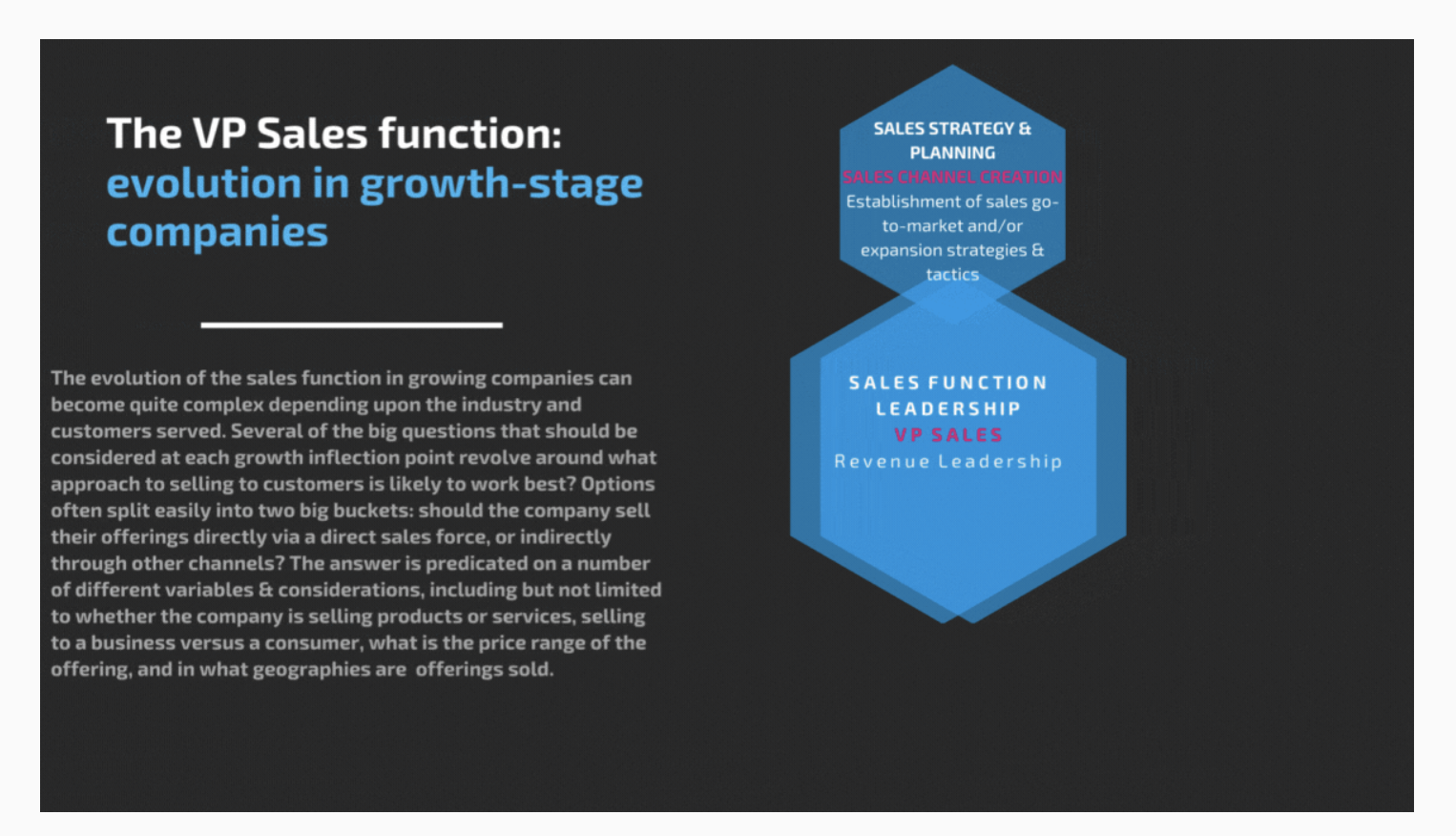
    The diagram below illustrates the intersection of competencies critical in the VP Sales position:

    Compensation

    Compensation is competitive with the position’s requirements.  In a performance-based environment, this will include base salary, incentive bonus structure based on both individual, department, and corporate qualitative and quantitative MBOs, and a stakeholder position in the company.

    Venture-backed Executive Compensation Study, VP Levels, West vs. East

    carrot-and-stickl2

    Periodically, we make an effort to pull together executive compensation trends and analysis focusing on venture capital backed companies in the United States.  The last executive compensation report we put out was in September 2009 (see prior blog post http://www.bostonsearchgroup.com/blog/ceo-compensation-analysis-west-east-founder/), and focused on C-level compensation, with a further contrasting of founder versus non-founder CEO compensation, both West Coast and East Coast.

    This report is similarly focuses on West Coast and East Coast differences in executive compensation, however this time looking at the VP level across the functional organizational structure.  For purposes of this report, only companies who broadly fit the definition of “information technology” were used in the analysis, not including biotech, medical device/medical technology, or cleantech.

    The titles looked at include the following–

    Vice President Business Development

    Vice President Engineering

    Vice President  Marketing

    Vice President Sales

    Vice President Sales & Marketing

    VP Software Development

    VP Product Management

    Note that below we’ve only included the analysis of the executive compensation data, in other words the deltas. If you’d like more detail and the information on which we based the analysis, please email damador@bsgtv.com with your name, title, company and business email address, and we can provide you with the baseline full report.

    Do keep in mind that this is only one set of data. To draw the best comparables, it’s important to do all three data-grabs listed above. Also, this is a “blended” sample set of multiple venture-backed industry sub-sectors in the information technology category. Some industry sub-segments may pay more or less than others with further parsing.

    West Coast Early vs. Later-stage Venture Capital-backed Companies

    West Coast Early-stage vs Late, Executive Compensation Tech

    Cash compensation is almost always higher in later stage companies, and this is reflected in all 3 quartiles of data analyzed.  For West Coast venture-backed companies, the differences are $15,000 to $50,000 in most roles, with an average different of about $25,000.  The only exception is for the VP Sales/Sales Marketing role, where cash was significantly higher in later stage companies for these roles, ranging between $75,000 to more than $125,000 in the top quartile companies.

    Conversely, equity is almost always higher in early-stage companies to offset the lower salaries referred to above.  For these West Coast companies, regardless of quartile, earlier-stage companies received on average ¼% to ½% more equity, with the biggest jump in VP Sales/Marketing, and lowest in the VP Engineering function.

    East Coast, Early vs. Later-stage

    East Coast, Early vs Later-stage Executive Compensation, VC backed

    East Coast compensation tells a different story from their West Coast counterparts.  Although cash compensation was similarly lower in early versus later-stage companies, East Coast executives of venture-backed companies didn’t see the “make-up” effect in equity.  In fact, equity appears lower in many of the quartiles compared, by as much as ½% comparing East Coast early versus East Coast later-stage.

    East Coast vs. West Coast, Early-stage

    East Coast vs West, early-stage, VC-backed executive compensation

    Cash compensation, East versus West, shows that West Coast executives of early-stage companies more often than not earn more in base .  West Coast Engineering is $10,000-20,000 more in base, VP Marketing is up West over East by $10,000 to $50,000. VP Sales/Sales & Marketing is actually the one notably lower cash category where East Coasters are better off than West in the higher quartiles (but not the lowest).  As noted above, West Coast early-stage executives are compensated more favorably when it comes to equity than their East Coast brethren virtually across the board.

    East Coast vs. West Coast, later-stage Venture Capital-backed Companies

    VP Level Compensation East vs West, Later Stage, venture capital backed

    As for cash compensation for later-stage companies East vs. West, a similar pattern existed being mostly lower than their West Coast counterparts, than its West Coast peers.  However, when looking at equity stakes in later stage companies East vs. West, the East Coast did better, often by ¼% to as much as ½%.