

The Anatomy of a Bankable Executive Team

We get hired to build early-stage executive teams by our clients every day. So we’ve seen our fair share of “team-building,” and much of what follows is likely intuitive to many. It is a combination of our experience and the collective wisdom of more than two dozen early-stage venture capitalists in the North East who we asked the question, “What does a ‘bankable executive team’ mean to you?”
Consider these criteria common denominators, or universal norms for investability. They are by no means exhaustive or complete, as each investor has his or her own individual criteria he or she leverages in selecting portfolio companies.
First, some qualifiers.
¨ Different stages require bankable teams with different profiles: angel versus early stage versus later stage mezzanine/pre-IPO.
¨ Different value kernels drive greater emphasis on one part of the executive team or another. For a deep science company in biotech, the chief scientist is going to carry greater scrutiny by investors. This also holds true for a software or hardware company where the technology leader will carry a greater weight.
¨ Investors tend to look at where the risks lie-technology risk or market risk for example. Something referred to as “execution risk” is all about the team being able to execute on the plan.
¨ Almost all VCs want to see a strong core team consisting of a serially successful CEO, a chief technologist with domain expertise in the area of the company’s product focus, and a veteran sales leader with a relevant rolodex and experience building a team that can score early customer wins.
¨ A strong board of directors, advisors, or scientific advisory board can help immeasurably, although won’t make up for significant lack of experience among the rest of the team.
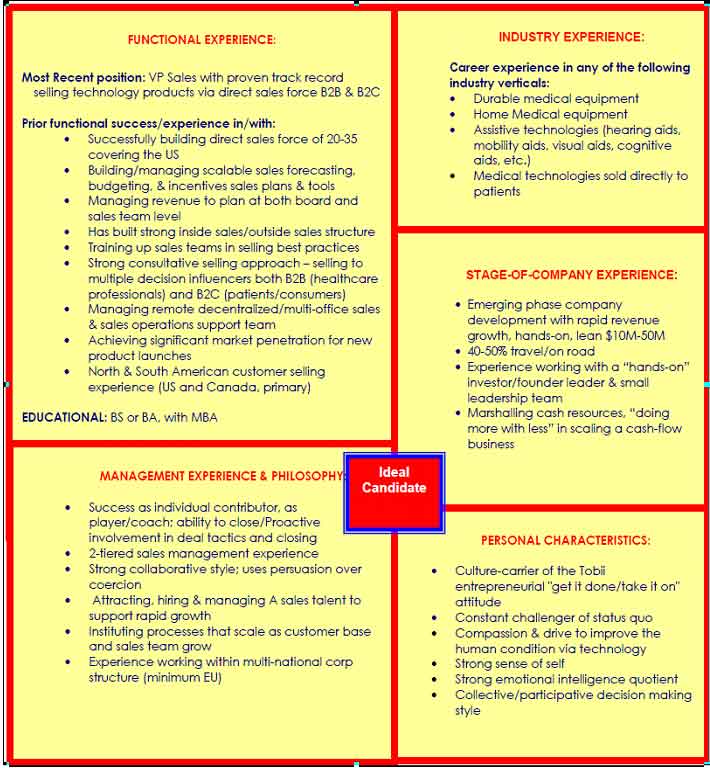
However, the above is like describing human anatomy as two arms and legs, a head and a torso. To drill down to more specific details, the grid below outlines the bankable team by function, team, and other characteristics.
The overwhelming preference by investors regarding “bankability” is an “experienced team.” The majority of VCs we talked to cited their number one concern as experience; those deals that get a ‘hard look’ have this fact in common. When asked what percentage of all business plans they receive have requisite experience on the team however, the number is well under half. And we all know that deals get done with first-time teams, even in this difficult financing environment.
Some of the other characteristics-when combined in the right amount and order-that are considered important criteria when an investor looks at financing a start-up team are listed below.
One VC actually tried to capture the essence of a bankable team with a mnemonic-FIRVOC: More


The last time I saw some confusion around why an executive was making a change in industry was back in 1997 to 2000. This was the dawn of the “internet age.” Executives were leaving traditional industries like financial services, management consulting, retail, and even manufacturing, because there was a new thing called the Internet that was going to “change the world.” In the earliest of those years of 1996 and 1997, there were the early adopters. These executives were truly missionary. Money hadn’t been made yet in the Internet sector, and trails hadn’t been blazed. Those early pioneers had caught a glimmer of a powerful disruptive technology, and were keen on experimenting with it, with the aim of changing the world as we know it, and how things get done.