

CEO Archives

Subscribe to the CEO RSS feed.

CEO Equity Compensation Calculator

carrot-and-stick, CEO Compensation

We’re often asked how to establish fair market compensation when it comes to CEOs of privately held companies, often with venture capital or private equity backing.

Below is one method that can be employed as a jumping off point for this calculus:

1)     “De-risked,” how much is a CEO worth?  Is  $500 -$1M a year too much?  For our purposes here, we’re talking about a talented CEO.  Not someone below average, but above the average, one that a retained executive search firm, venture or private equity investor, or board of directors would be proud to put in the role.   Rather than pick some arbitrary number, this should be  ”market set,” by looking at what someone working for any global 2000 company (i.e. General Electric or other similar) earns annually.  From our executive search experience and database of compensation comparables in these companies, base salary is usually between 250K and 400K, depending upon how big the divisional P&L responsibility is, there is usually a bonus that is between 50-100% of base, and an LTIP (long term incentive plan) that-once partial vesting begins-can generate from 100K up to 250K or more a year in cash.

2)     So, the cash component of a comparable, including average base, annual average bonus, and yearly LTIP pay-out looks something like this:

Base ~ 300K

Bonus ~250K

LTIP (cash only) ~ 200K

TOTAL: 750K

* This does not include any meaningful RSUs (restricted stock units) that are usually also part of that package, which could add another 200K or more per year in value to a general manager’s package with true P&L responsibility for their division, group, or sector/segment.

* This is also not indexed to geography/cost of living.  If the position is in New York City tri-state area (New York, northern New Jersey, southern Connecticut), San Francisco, Boston, London, Singapore, Hong Kong, or Tokyo, a multiplier factor needs to be used to level-set for cost of living increase required for those metropolitan areas.

3)      Now, back out the cash portion of a CEO’s compensation for the company that they’re stepping into (say 250K a year in cash in smaller companies as all base, or combination of base + cash bonus).  So you’re left with say 500K that needs to be made up in equity, on a per anum basis.

4)      Over how many years is the liquidity horizon (and/or vesting rate, 3, 4 ,5 years)? Let’s say it’s 4 years, at net 500K, equals ~$2 million

5)      Now, this is with ZERO beta risk factor.  Add back the beta risk of an earlier stage company.  Let’s assume a global 200 company equals “1.”  A CEO role in a privately held, externally backed company is not “1″.  It’s probably a multiplier of 1.5, or 2.  For a pre-revenue, VC-backed company with high burn rate, it could be as much as in the 3 to 5 range.  Note that any illiquid company is inherently risky in terms of cashing in any equity at a reasonable price.  Let’s pick a beta risk multiplier of 2.5 times riskier than “average.” So, 2M * 2.5 = 5M.  Note that when there are preferences for the investors that create an exit hurdle rate before any common shareholders get paid, beta risk goes up accordingly unless the CEO participates in any exit event via cash carve out or other instrument.   As mentioned above, a recent IPO that represents a reasonable market comparable netted a CEO who joined the company 4 years ago $20M.  Using this number, the CEO’s compensation was $5M a year, or a beta multiplier of approximately 5.

6)     Then, are there any combat pay provisions you need to add in (warts that a CEO or executive team member is required to overcome and vanquish in their role that are above and beyond the normal call of duty)-reconstituting the executive team, or raising an outside round of capital because existing investors are tapped out, or starting up an Asia manufacturing capability that will require the CEO to take a dozen 15-hour flights one-way to get up and running.

7)      Finally, you have to look at what likely dilution there is going to be to an initial options grant for the CEO.  If you start with a 6% stake in an early stage company in a Series A funding, and you then raise a series B and C, depending upon valuation for those rounds, the CEO will likely end up below 3% as a “fully diluted” stakeholder.  There is an argument to be made that any of the management team critical to the success of the company will be “topped off” at later funding events in order to keep them motivated.  However, there is no guarantee that this happens.  It’s only good business sense to do it.  For the CEO, it is more important what s/he ends up with, not how much with which they start.

8)     Add water, and stir…

Notes & disclaimers:

  • * This is not intended to be biased in any direction, to any party, neither CEO candidate, nor company and/or investor.
  • * This is only one way of calculating compensation, indeed there are many others.
  • * There is no way an earl- stage emerging/growth company will be able to compensate a CEO in all cash, nor truly be able to offset the risks inherent in this stage of venture.  The CEO either accepts this, or is not truly capable of working successfully in this milieu.
  • * Other than the impact of cost of living  adjustments to base compensation, each CEO candidate comes with what we refer to as their own subjective “keep the lights on” cash needs.  We calculate this simply as the amount of cash required on a yearly basis to cover their living/family obligations without having to write checks out of savings to cover it.  Some CEO candidates may have 3 children in private school or college, while others may have no children and no mortgage.  Cash needs therefore may range widely, and need to be adjusted for using equity as a “leveler” (less cash-needy, higher the equity, and vice versa)
  • * Alternatives to paying bonuses in cash might be to pay bonuses in equity, upon achievement of key milestones for the company
  • * This same calculus can be applied to the Vice President level as well, subject to appropriate adjustments downward in cash and equity
  • * In a circumstance where there is a “turn-around” required, equity may not be enough of a certainly to attract a competent CEO for the challenge ahead.  In these circumstances, a cash carve-out may be warranted in addition and/or in substitution for a stakeholder role.  The cash carve-out may be just for the CEO, or for the key management team required to achieve the turn-around.  Often, the cash-carve out structure is a percentage of total sale price over a certain amount, with the possibility for an accelerator depending upon exit/liquidity circumstances/outcome.
  • * Often the question of anti-dilution comes up in an effort to assure a CEO of a certain percentage of equity upon liquidity.  Granting 5% equity to a CEO at a Series A financing with anti-dilution would ensure that the CEO retained his or her stake across the growth and additional funding needs of the company.  However, this is rarely a good mechanism, as the CEO becomes less interested in new company valuations at subsequent funding events, and becomes misaligned with the company’s investors.

CEO compensation Analysis, West vs. East, and Founder vs. Non-founder

carrot-and-stickl

We are often asked to do some executive compensation “ciphering” on behalf of our clients.  Getting an accurate read on market compensation is always a bit of fuzzy math.  You can call around to those you think may know or are in those positions now, you can commission a survey, or dig into some of the executive compensation databases that pre-exist.  We often do all three on behalf of our clients.  However, the below numbers are based on the Dow Jones executive compensation data collected several times a year, targeting venture-capital backed companies in the U.S.  The companies surveyed cover early stage seed-round and Series A, through later funding stages, and companies that are pre-revenue through shipping product and profitable.  From an industry perspective, the below data is an amalgam of all venture-backed industry sectors in the U.S., including technology (software, hardware, services, interactive media, etc.), sciences (biotech specifically), medical devices, cleantech / renewable energy, and other related fundable venture sectors.

For this bit of ciphering, we’ve focused on three executive compensation comparisons involving CEO compensation–

1)     West Coast versus East Coast, and the differences that may exist between them

2)     “Founder CEO” vs “non-founder CEO”

3)     and early stage CEO compensation vs. later stage companies and associated CEO compensation within

This is always an interesting analysis.  Each category of CEO always feels as if the other is getting a “better deal”-CEOs on one coast think it’s likely better on the other, and founders and non-founders often feel the other has a better package.  Similarly, early-stage CEOs are often jealous of the “rich cash packages” that they seem to hear about in later stage companies, and late-stage CEOs always feel that early-stage CEOs get so much more meaningful an equity position than they as “hired guns” seem to be able to garner.

Note that below we’ve only included the analysis of the executive compensation data, in other words the deltas.  If you’d like more detail and the information on which we based the analysis, please email damador@bsgtv.com with your name, title, company and business email address, and we can provide you with the baseline full report.

Do keep in mind that this is only one set of data.  To draw the best comparables, it’s important to do all three data-grabs listed above.  Also, this is a “blended” sample set of all venture-backed industry sectors.  Some industry sub-segments may pay more or less than others with further parsing.

Highlights of the analysis

In the first “delta” table, we took a look at West versus East for early stage start-up/product development focused companies.   What was apparent in this earlier stage company setting was most recently, West Coast early-stage CEOs  on the whole have lower cash packages in both base and bonus. In addition, an equity analysis also returns 1-2% less on the West Coast than East in this data set in the lower quartile and median.  However, in the top quartile compensation range (those CEOs who have compensation in the top 25% of all CEOs surveyed), West Coast CEOs outearned East Coast in both cash (by only $13,000) and equity (a full 1% more).  Another interesting data point is that West Coast CEO’s have more upside in terms of bonuses (an average of 27% of their base compensation) than East Coast CEO’s whose bonuses are an average of 16% of their base compensation.slide11

In later-stage companies where they are already shipping product, West Coast founder CEOs are paid less cash and ultimately hold less equity than East Coast founder-CEOs, except again for the top equity quartile, where West Coast founder-CEOs make up for less cash with +4% more equity on average than East Coast founders.  However,  West Coast bonuses for CEO are 29% of their base compensation while on the East Coast, CEO bonuses are 22% of base compensation.

West Coast non-founder CEOs (hired guns) make more than East Coast in cash only.  Equity is about the same, East vs. West.

On the East Coast in later-stage companies professional president/CEOs are paid less cash and hold less equity vs. similar founder CEOs.

On the West Coast, the pattern that Noam Wasserman at HBS has observed does prove out–  that non-founder CEOs get paid less cash compensation, but hold much more equity than their non-founder CEO counterparts (see http://founderresearch.blogspot.com/)

slide21

Cleantech CEO Poll: Is the carrot of stimulus dollars influencing your strategy?

We’ve begun to circulate weekly questions posed by CEOs of other peer-CEOs in an effort to bridge the knowledge gap.

These questions range from fundraising to economy related,  compensation, board management,  product development,  sales etc.

This week’s question is industry-specific to cleantech, only circulated to CEOs in the broadly defined cleantech segment:

All your responses are anonymous due to the nature of the polling software employed above.   Prior CEOs’ cumulative responses are available immediately after answering the question here. The response will also be forwarded by email within a week of the poll launch.

Ours is a two-part value in this Q&A exercise:

  • validating the respondents as posessing the experience required to answer the question(s) with authority, and
  • retaining the buffer between asker and answerer

Thanks in advance for your input.

CEO Peer Survey, August 2009 — Preparing for Recovery?

istock_000005846970xsmall

Below is the hyperlink to our latest CEO peers “speed-survey,” exclusively for growth-stage CEOs.  Topic– “Preparing for Recovery?”

http://surveys.polldaddy.com/s/D3642F14267CCC14/

We at BSG Team Ventures periodically take the temperature of the markets we serve. This speed survey is no more than 10 questions, simple multiple-choice.

Knowledge is power.  Aggregated peer-provided knowledge is “actionable power.”

We make an effort to survey only those who fit the category (in this case, sitting CEOs or board member/founders of technology/science-driven growth-stage companies). [Note, if you don't fit the aforementioned description, please refrain from responding.]

Feel free to forward to the qualified CEOs in your sphere of influence.  The more data generated, the more accurate the trend lines.

All responses are anonymous due to the web-based survey technology employed.

We will forward the survey results within the next two weeks to the email address on file.  Please let us know if there is another email address you wish us to send the results to as well.

What Type of Leaders are Required to Outpace Your Competitors in a Recovering Economy

Competing Sports Cars Racing

A few months back in the New Yorker Magazine (May, 2009, http://www.newyorker.com/reporting/2009/05/11/090511fa_fact_gladwell ), Malcolm Gladwell penned a really interesting article on the subject of how underdogs-when they change the rules of the game-can beat stronger, bigger rivals. This is a story told many times over, starting with the Biblical story of David beating Goliath, which Gladwell uses in his article as the first of two fulcrums to work the concept out. The other fulcrum he uses is a girls basketball team on the West Coast that had as its coach a successful entrepreneur, Vivek Ranadivé, accustomed to innovating the rulebook to a start-up’s advantage as founder, Chairman and CEO of TIBCO Software, $1+B enterprise value publicly traded start-up success.

In the case of Gladwell’s article, the girls basketball coach was not given any special “talent” as an asset to build around. In fact, kids’ teams at younger ages are most often randomly assembled, with no “draft picking” involved. So, Randivé had to play with the hand he was dealt. He ended up with no tall girls, nor good shooters, just moldable clay, where a winning strategy would have to prevail over a special selection of talent.

In professional sports as well as business, however, coaches/CEOs get to pick their teams. And for business, there is no more crucial time to think about executive team-building than now. According to most analyst reports, markets are preparing for growth. The strongest competitors in each industry were the first to streamline operations at the beginning of the downturn and make sure their financial houses were in order. Now these leaner and meaner companies are looking to leapfrog their competition as recovery sets in. If a rising tide floats all boats, the top companies in each industry sector are looking for a way to rise at a faster rate than their weaker rivals. A recent McKinsey report framed this competitive dynamic, saying:

Roughly one in three industry leaders was toppled during the previous recession as attackers used the downturn to their advantage. Recent big acquisitions in sectors such as pharmaceuticals and information technology suggest that the current slump will be no different.

Our research shows that while all companies in an industry typically suffer during a recession, the performance gap between strong and weak rivals tends to widen. This gives strong players more opportunities to reshape their competitive environment. [http://blogs.harvardbusiness.org/hbr/hbr-now/2009/07/trend-to-watch-industries-taki.html]

But, how should these companies go about accelerating around the executive curve into the straight-away of economic expansion?

Sticking with basketball as a parallel for what one business can do to accelerate their rise over their peers, is it possible to consider hiring a superstar in a key area of the business?  A Michael Jordan of the Bulls, or Kevin Garnett of the Boston Celtics, or L.A. Lakers’ Kobe Bryant?  However, what should the latest definition of “superstar” be in light of all the change the recession has wrought in the business landscape?  McKinsey’s article went on to chronicle 10 key changes in the global competitive topography that are “must-be- aware-of’s” when re-engaging in strategic planning for the recovery in 2009 and beyond.  In July’s issue of Harvard Business Review, one answer is to bring on an executive with what Ron Heifetz and Marty Linsky call “adaptive leadership” ability-

The current economic crisis is not just another rough spell. Today’s mix of urgency, high stakes, and uncertainty will continue even after the recession ends….

Instead of hunkering down and relying on their familiar expertise to deal with the sustained crisis, people in positions of authority-whether they are CEOs or managers heading up a company initiative-must practice what the authors call adaptive leadership. They must, of course, tackle the underlying causes of the crisis, but they must also simultaneously make the changes that will allow their organizations to thrive in turbulent environments.

Adaptive leadership is an improvisational and experimental art, requiring some new practices.

[http://hbr.harvardbusiness.org/2009/07/leadership-in-a-permanent-crisis/ar/1 ]

The adaptive leader has a greater agility than other leadership types. The adaptive-leader type also allows for optimal breakthrough performance coming out of a down cycle.  Generic adaptive leadership is not enough, however.  You still need to figure out where you topgrade your executive team to best capitalize on the upside afforded in an executive change.  Do you seek this new “adaptive leader” for marketing, strategy, operations, sales? General management of one business unit that’s high growth versus another that’s slower growth but lower risk? Or is it in new product development, R&D, or international/global specialization?  At the risk of overplaying a metaphor, coming back to basketball for a moment, it’s interesting to note that each successful professional team has often been built around one “superstar” player, but not always playing the same position.   There are 3 traditional positions in basketball-guard (2), forwards (2), and a center.  Magic Johnson was a guard (point guard to be specific) and he took the Lakers to several championships.  A current L.A. Lakers superstar, Koby Bryant, as well as the Boston Celtics Paul Pierce are also guards.  However, Larry Bird and Julius “Dr. J” Irving were forwards.  And not to leave out the third successful superstar permutation, Shaquille O’Neal, Wilt Chamberlain, Kareem Abdul-Jabbar, and Patrick Ewing were all “superstar” centers who repeatedly drove their teams to pennant victories.

Once you identify where the biggest impact can be made via topgrading your current executive team, and you pre-select for a leader with proven adaptive leadership skills and experience, the final question presents itself-where are adaptive leaders most frequently bred?  Where should you look for them, what ecosystem have they been building there leadership toolbox within?

Our experience indicates that a disproportionate  number of adaptive leaders come from professional backgrounds they’ve honed in two specific stages of the company lifecycle-

different-leaders-for-different-companies-stages-bsgtv

At our firm, where we specialize in recruiting adaptive leaders, we’ve broadly referred to the executives who are best equipped at leading the green-highlighted columns above of emerging and growth-stage as “Builder-Leaders.” However, whether we refer to them as “builder-leaders” or “adaptive leaders,” their experiences creating and growing companies in these stages are the foundational criteria for success for those companies looking to outpace their competitors as we come out of a down cycle and head into the next growth phase.

The winning formula for extra-ordinary company performance in this next economic expansion is a combination of good internal executive assessment as to which role(s) will give you the biggest step-function impact if you topgrade them, and a key attribute of “adaptive leadership” in the new executive you bring. This is the very same leadership characteristic Malcolm Gladwell’s Vivek Ranadivé demonstrated when he was coaching his daughter’s basketball team to compete and win against the rest of their basketball league.

Success Metrics for Newly Hired Executives

Below is the final tally on top metrics for measuring executive success in the C-level and VP level team CEOs bring on board to help them executive on their businesses.  Thanks to the CEO input of more than 60 poll responses to this latest venture-backed company CEO survey.

The question we framed was phrased as follows:

“In evaluating the success of an executive hire after 12 months, what would be the top 3 criteria that you would use?”

The first choice from the poll results is somewhat self-evident– that the executive has exceeded performance expectations (goals, milestones, objectives, etc.) for the specific role from the CEO’s perspective.

However, the second most popular metric was “established internal and external reputation as functional expert.”   Essentially, this means that the executive has built his or her own political/social capital with internal peers and external influencers, customers, vendors, or other external relationships key to the success of the company.

The third most important metric was “culture fit.”   This was selected over the other 4 remaining metrics offered by a more than 2 -to-1 margin.

The question that pops up is how a CEO might best measure the  #2 and #3 metrics.  For both of these metrics perhaps a 360-degree review at the end of 12 months would be beneficial.  There are tools offered by the likes of the Hay Group and others that do an online version of this contextual employee review that can be quite useful to determine an objective read (see http://www.haygroup.com/tl/Questionnaires_Workbooks/Emotional_Competency_Inventory.aspx ).

Perhaps it would also be interesting if an executive search firm who brought a candidate to an organization also made this part of their fee structure.  And facilitated the process/offered the tools to make it happen.  Food for thought.  The goal of the executive recruiter would be to serve as that often mythical “trusted adviser” of executive talent, facilitating as much objectivity around executive team-building and talent assessment as possible.

Worthy of note is the fact that “integrity” ranked near the bottom of the list of success criteria.  No doubt CEOs assume perhaps that this is a given in any candidate.

success-metrics-for-new-executive-hires-6-2009

Most Common Reasons Why CEOs Fail– Venture Capital’s Perspective

After quite a bit of discussion was sparked on an earlier blog post in March around the 7 Reasons why early and growth-stage CEOs fail (http://www.bostonsearchgroup.com/blog/7-reasons-ceos-fail/ )in technology-driven innovation-stage companies, we thought we’d get the venture capital perspective.  Below are the results.  The two biggest reasons behind CEO failure revolved around a CEO’s inability to balance revenues and burn-rate (23%), tied with the CEO’s inability to hire well at the VP level, with repeat VP-level failure/turnover (also ~23%).  The balance of forced ranking of CEO failure include categories such as–

- New CEO didn’t integrate with rest of incumbent team

- Business model changed (different horses for different courses)

- Leadership fatigue (plateauing company for too long a period)

- CEO “Peter Principle,” and

- CEO getting sideways with Board of Director(s)/ board chemistry

vc-survey-graphic-results-march-2009-why-ceos-fail1

VC survey: Top Reasons CEOs Fail

From the venture investor’s perspective, what are the top reasons CEOs fail in venture-backed early and growth-stage companies?

Below is a poll aggregating responses.  For VCs taking the poll for the first time, check out prior blog post at http://blog.bostonsearchgroup.com/7-reasons-ceos-fail/  for further detail on some of the possible reasons short-handed below.

Feel free to forward to other qualified investors.  [Please note, it's the honor system on investors only.  In other words, please resist the temptation to stack the deck or share "opinion."  Experience only.]

For summary of Harvard Business Review article written a few years back around “Why Entrepreneurs Don’t Scale” see below poll.

[Poll closed. See blog post at http://www.bostonsearchgroup.com/blog/common-reasons-ceos-fail-venture-capitals-perspective/ for for results.]

Founder “Peter principle.” This has been well-documented by others, most notably by John Hamm, venture capitalist at VSP Capital and leadership development coach who authored a Harvard Business Review article a few years back, titled “Why Entrepreneurs Don’t Scale.” To set up John’s observations, most of our time as executive recruiters, we focus on helping early-stage companies jump the leadership chasm from entrepreneurial to professional leadership. More often than not, there is absolute certainty that a casualty will occur- the only question is whether that casualty will be the founder(s), or the company. Where venture capital or private equity is involved, all is done to avoid the latter in favor of the former. Regardless, it is too rare an occurrence when this collision between founder CEO, growth mandate, and outside investors ends positively, and if the company survives, it has to deal with the emotional baggage of shedding this first founder layer and all the pain this brings with it. John outlines four management tendencies that work for smaller-company environments but become Achilles’ heels as these CEOs try to scale their companies. The first tendency is loyalty to founding team mates. In entrepreneurial mode, you need to lead as though you’re in charge of a combat unit on the wrong side of enemy lines where anyone on your team is a keeper. However, in larger company growth mode, blind loyalty can become a liability. At some point, it may be required that the rest of the team that started the company with the CEO may need to be changed out for an executive team with experience at the “growth-stage” versus just the “start-up” stage. The second tendency, task orientation, is critical in driving toward a big initial product launch, but excessive attention to detail can cause a growing organization to either suffocate under such leadership-one that can’t generate creative ideas or momentum without being instructed by the CEO-or lose sight of its long-term goals. The third tendency, single-mindedness, is important in a visionary CEO who is unleashing a revolutionary product or service on the world. However, this can limit the company’s potential as it grows, as all good ideas aren’t always born from one person. In addition, often a lack of self-awareness or “emotional intelligence” can create a large blind spot around what isn’t working with the original idea, and instead of an ability to iterate to a better but related idea for the marketplace, the founder CEO can become caught up in the initial “vision” and stick to it regardless of external market input that would indicate changes to the initial value proposition are needed to capture broader market adoption. The fourth tendency, working in isolation, is fine for the brilliant scientist focused on an ingenious idea, technology or science. But it’s a non-starter for a leader whose expanding organization increasingly relies on people other than the CEO. There is also a significant difference in skill set required when the company grows beyond a single layer of management, requiring, VPs who manage directors, who may manage managers. Managing through a multi-layer management system requires a very different managerial toolbox. As the summary for the article outlines, “Leaders who scale deal honestly with problems and quickly weed out nonperformers. They see past distractions and establish strategic priorities. They learn how to deal effectively with diverse employees, customers, and external constituencies. And, most important, they make the company’s continuing health and welfare their top concern.”

7 Reasons CEOs Fail

Executive Organization Chart

Is executive retention a problem one might ask?  From our own experiences in search, we felt it was.  Educators and consultants alike have taken a more objective and statistically relevant approach to outlining the problem. A 2001 study of executive failure done by Executive Search Information Exchange pegged the average failure rate for recruited executives in their first year at between 40% and 50%.  More recently Michael Watkins,a recognized thought leader in executive leadership and author of The First 90 Days, has revealed from his research that a staggering 58% of new executives hired from the outside fail in their new position within 18 months.

The cost of executive failure? A Mercer study estimated that it's often more than $500,000 or 2.5 times salary. And this doesn't include organizational, opportunity, productivity, and transitional costs for the new executive (Mercer et al, 1999). Including these other components of executive hiring, the calculus for fully loaded cost to the organization per failure at the executive level can top a million dollars (Fortune Magazine).

After spending a decade or more as an executive recruiter working on early & growth-stage CEO searches, it seems worthwhile to take a look-back on some of the reasons CEOs seem to fail.  In fairness, we’re a boutique firm, so the sample set isn’t hundreds of searches.  However, it’s also more than anecdotal, as for every CEO search we’ve done, there was a high probably that there were several CEOs who had already come before our search, and in doing a thorough CEO replacement search, we are students of why predecessors failed in order to ensure we don’t repeat others’ past mistakes.  Another macro observation is that these failures don’t seem to be different from practice area to practice area, or geographic region to geographic region.  We’re a multi-specialty firm, yet we don’t see that software/ Internet/ media CEOs fail for dramatically different reasons than medical device CEOs or cleantech or biotech CEOs.   Nor is there great variability when you look at CEO searches in one innovation center versus another. With presence in Boston and New England, New York and the Tri-State area, Silicon Valley/San Francisco, and London/Cambridge, England, we’ve been able to test this and haven’t witnessed much foundational difference one area versus another.

The following 7 reasons below cover the vast majority of CEO executive failures we’ve seen:

1.      Failure point #1: Founder “Peter principle.This has been well-documented by others, most notably by John Hamm, venture capitalist at VSP Capital and leadership development coach who authored a Harvard Business Review article a few years back, titled “Why Entrepreneurs Don’t Scale.”  To set up John’s observations, most of our time as executive recruiters, we focus on helping early-stage companies jump the leadership chasm from entrepreneurial to professional leadership.  More often than not, there is absolute certainty that a casualty will occur– the only question is whether that casualty will be the founder(s), or the company.   Where venture capital or private equity is involved, all is done to avoid the latter in favor of the former.  Regardless, it is too rare an occurrence when this collision between founder CEO, growth mandate, and outside investors ends positively, and if the company survives, it has to deal with the emotional baggage of shedding this first founder layer and all the pain this brings with it.   John outlines four management tendencies that work for smaller-company environments but become Achilles’ heels as these CEOs try to scale their companies. The first tendency is loyalty to founding team mates. In entrepreneurial mode, you need to lead as though you’re in charge of a combat unit on the wrong side of enemy lines where anyone on your team is a keeper. However, in larger company growth mode, blind loyalty can become a liability.  At some point, it may be required that the rest of the team that started the company with the CEO may need to be changed out for an executive team with experience at the “growth-stage” versus just the “start-up” stage.   The second tendency, task orientation, is critical in driving toward a big initial product launch, but excessive attention to detail can cause a growing organization to either suffocate under such leadership–one that can’t generate creative ideas or momentum without being instructed by the CEO–or lose sight of its long-term goals. The third tendency, single-mindedness, is important in a visionary CEO who is unleashing a revolutionary product or service on the world.  However,  this can limit the company’s potential as it grows, as all good ideas aren’t always born from one person.  In addition, often a lack of self-awareness or “emotional intelligence” can create a large blind spot around what isn’t working with the original idea, and instead of an ability to iterate to a better but related idea for the marketplace, the founder CEO can become caught up in the initial “vision” and stick to it regardless of external market input that would indicate changes to the initial value proposition are needed to capture broader market adoption. The fourth tendency, working in isolation, is fine for the brilliant scientist focused on an ingenious idea, technology or science. But it’s a non-starter for a leader whose expanding organization increasingly relies on people other than the CEO. There is also a significant difference in skill set required when the company grows beyond a single layer of management, requiring, VPs who manage directors, who may manage managers.  Managing through a multi-layer management system requires a very different managerial toolbox.  As the summary for the article outlines, “Leaders who scale deal honestly with problems and quickly weed out nonperformers. They see past distractions and establish strategic priorities. They learn how to deal effectively with diverse employees, customers, and external constituencies. And, most important, they make the company’s continuing health and welfare their top concern.”

2.      Failure point #2: Unable to “imbed” with the existing team. This is all about forging meaningful bonds, trust, and a following with the existing executive team/staff/employees as the “newcomer.”  This is most often the cause for CEO failure when an outside CEO is brought in as the first successor to the founder CEO.  We refer to it as “organ rejection.”  The host organism (the company) has a high degree of the founder CEO’s DNA in it.  That founder CEO has proven that they are a miracle worker, coming up with the idea, building it out through proof-of-concept on a shoestring budget, getting venture or other funding for the idea, that the rest of the employees who imprinted on the founder CEO “reject” the new CEO as an “imposter” or “foreign matter.”

3.      Failure point #3: Getting sideways with the board. As executive recruiters, we hear this often.  A CEO, whether founder or non-founder, doesn’t gel with the Board of Directors.  In the case of a growth-stage company, there is often outside capital involved, and investors who serve as part or all of the board of directors.  A CEO’s inability to quickly understand the drivers of each board member, and inability to build a communication bridge that may be unique to each board member, is very likely to fail, regardless of whether growth milestones are being hit or not.  One a board member loses faith in a CEO, it’s very hard to win that faith back.  Activities that often alienate a board include hiring issues (holding on to existing employees too long, or holding off on hiring into a key role, board communication issues (not sharing the bad with the good), lack of realism around budgets and burn rate and unwillingness to make the tough decisions, etc.)

4. Failure point #4: Inability to balance revenue/burn rate There is always a constant struggle between CEO and investors if the company has a net burn rate (spending more cash than revenue coming in the door).  Just last week, I heard from a venture capitalist who said that a CEO, during a board meeting, said that he was unwilling to cut the burn rate for fear of being unable to scale fast enough to meet demand once the product “got traction.”  The VC then said, “After the board meeting, I got a call from one of the other investors, expressing concern that the current CEO just didn’t understand the realities of the situation, and he felt it was time to start a search for a new CEO who did.”  Often, this is a circumstance where the CEO has come from a larger company environment, and has rarely if ever faced a situation where “out of cash,” is a literal term, versus just a euphemism for asking the parent corporation for some more capital.

5.      Failure point #5: Inability to hire well. There is an expression, “the first time, shame on you, the second time, shame on me.” This is what the board of directors often employs when a CEO can’t find the right VP level executive to successfully fill a key seat on the management team.  Often, it’s the VP Sales.  When the product is still in development, it’s often the VP Engineering.  However, if the CEO churns either of these positions with several candidates that don’t end up meeting board expectations, ultimately the board feels it’s perhaps not these VPs, but rather the CEO who needs to be changed out.  When a VP Sales commits to a revenue target, and then misses it repeatedly, often the CEO and board decide to make a change in the VP Sales.  multiple replacement in a single role, VP Sales, or VP Engineering) (blaming someone else

6.      Failure point #6: Change of business model. Part of emerging & growth stage company building is the iterative approach to finding the magic business model that takes root and thrives.  At times, founders, investors, and early team members develop a thesis on what model they’re going to chase first, and hire a CEO into that thesis.  However, as often as not, the early iterations miss their mark, and the ultimate business model that evolves as the winner is one that doesn’t play to the strengths of the earlier CEO hired.   In this eventuality, it’s much like “no fault insurance.” Neither driver is at fault, but in the best interests of the company, the earlier CEO hired needs to be changed out to make room for one better tailored for the market approach the company finally settles on as bedrock on which to scale the company.

7.      Failure point #7: Leadership fatigue.  At times, running a company turns into a grind.  The company doesn’t grow as fast as anticipated, or the magic formula for business model doesn’t materialize.  Or the executive team doesn’t come together as all wished at the beginning.  At this point, the company doesn’t fail or flame out, but nor does it continue to show healthy growth and positive direction.  Sometimes, a company grows for a bit, then plateaus and efforts to move the proverbial needle continue to fall short.  One of my favorite expressions comes to mind, “The definition of insanity is doing the same thing over and over yet expecting a different result.”  If most all other variants and permutations have been tried, no doubt it’s possible that leadership fatigue has set in and the company is in need of a fresh horse.

There certainly are other subsidiary reasons that less often cause failure-a CEO not being technical enough to shepherd a pre-revenue start-up through early product development stages into successful commercialization, or not enough industry domain expertise in an area where a Rolodex of relationships are critical to obtaining early customer wins or market credibility.  However, for the most part, these and many other one-off failures function as exceptions to the larger CEO failure points outlined above.

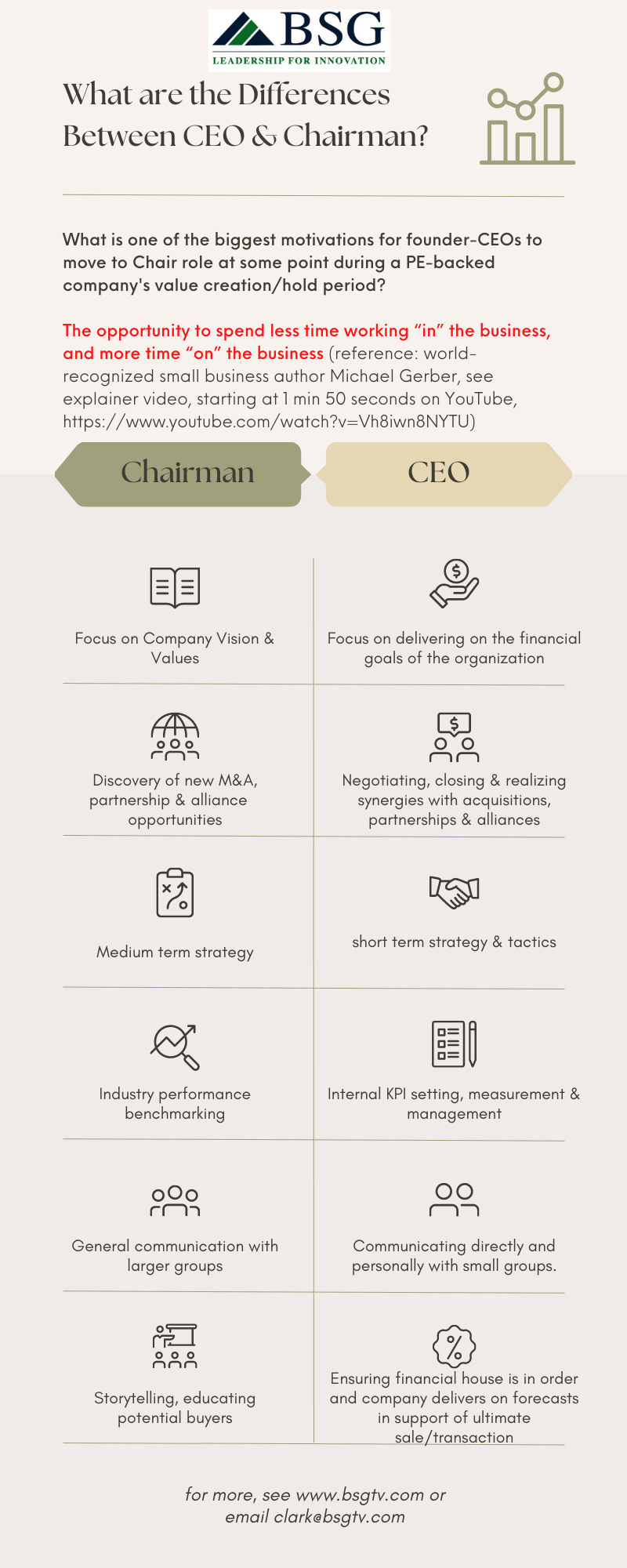
One of the questions that naturally follows in exploring the most typical reasons for failure is what steps, actions, or changes can be made to optimize the probability for CEO success?  Is there “another way of doing it?”   One of the best ways we’ve found is to split the Chairman and CEO roles.  However, this is a topic for another discussion.  It’s something that’s actually done in the UK as SOP, and even out in Silicon Valley more than in Boston or New York.  We’ve executed our fair share of executive searches in each, and comparing the perspectives around leadership-sharing held by venture or private equity investors is interesting grist for further analysis.

Applying post-Katrina lessons learned to Current Economic Hurricane?

I was traveling on business recently and spent some time down in New Orleans.  It was the first time I’d been there after Hurricane Katrina.  My hosts were fellow entrepreneurs, also part of EO (www.eonetwork.org) and on the board of the local chapter there.  They put together a private tour of New Orleans, with a focus on the issues that led to the spectacular and tragic failure of so many systems post-Katrina.  As one of my hosts put it, it was a breakdown of three things –   vision, leadership and communication.  The more we drove around New Orleans and the more I saw of the devastation, the more I heard of how these entrepreneurs responded to it.  I got this strange feeling of metaphoric déjà vu.  And then it dawned on me.  Katrina is a parallel for the current economic crisis America finds itself in– a sudden, unpredicted disaster for which none of us were prepared.   So I asked Jude Olinger, the current EO New Orleans Chapter President and CEO of market research firm the Olinger Group, if he had any “lessons learned” that he felt might apply to any unpredictable, catastrophic disaster.  His response? Oh yeah.  In fact, Jude had sat down several months after Katrina, and tried to capture the lessons learned.  He emailed them to me after our meeting.  And what I saw was an eerie parallel in the lessons Jude learned surviving and succeeding post-Katrina to what each of us--entrepreneur, business person, head of household, individual–could also adopt as survival strategies in one of the biggest financial hurricanes ever to hit the U.S. in modern times, perhaps the globe.   As much as entrepreneurs drive the economy, and no doubt recovery, we all should think of heeding these lessons.  In reflecting on the below, I saw them universally applicable to all current innovation sectors in which we as an executive search firm have practice areas, whether cleantech / energy, medical devices, software, biotech, distance learning / education, Internet Web 2.0, mobility / wireless.  In chatting with CEOs in each of these sectors to test my assumption, they too felt these were “universal truths.”

Below is a partial list of Jude’s lessons learned, selected for those that carry strong correlation both to a natural disaster such as Katrina as well as an economic disaster.  Following it is some interesting Q&A in dialoging with him about the experience.  And to learn more about Jude Olinger’s firm, go to www.olingergroup.com.

After crisis strikes…

-         Lesson #1 - Don’t panic but act quickly.  Stay focused on the tasks that you have to accomplish to recover.  Prioritize tasks and act upon them immediately.  Time, or rather lack of time, is your enemy.  Everyone is going to want your time… so have to prioritize and think ahead.  Anticipate things that might happen and prepare for them.  If you know you have to lay people off, and it’s a reality, then do it.

-         Lesson #2 - [In knowledge worker industries] Don’t lose your greatest asset – your employees.  Be decisive.  Communicate with employees quickly and frequently.  Be a leader and let them know the plans and intentions of the company and how they fit in.  Evaluate what you can do for them immediately and provide as much assistance as possible.  Don’t lose the key people that make you successful every day

-         Lesson #3 - Communicate with your clients and vendors quickly.  Let them know that you are still in business and intend to fulfill your obligations.  There often is  client empathy and understanding for about a week.  Then clients start to look to mitigate their risk by moving business-all or at least part of it-to another provider just to reduce their risk.   Keep them from defecting.  IF they don’t hear from you, then they’ll assume that risk is real in continuing to work with your firm..

-         Lesson #4 - Locate your advisors (accountant, insurance agent, banker, attorney) quickly and leverage their knowledge/expertise in the recovery.  These relationships should become PERSONAL…  you need to know your banker’s wife, husband, and children….  For accountant/bankers, questions like:  ”Should I do a 25% paycut?” (accountant/CPA), or “Will banks offer any forebearance in the interim?”

-         Lesson #5Be selfish with your time - everyone will want it, and you won’t have enough of it to go around.  Tend to your personal relationships and yourself.  Crisis will test you mentally, physically, and emotionally and you will need all of your strength and energy to survive it.

-         Lesson #6 - Get the facts - not things reported as fact by the media – before making any major life or business decisions.  Lots of false rumors will abound.  Filter information carefully.  Be as close to the information as possible – the further you are away from it, the less accurate it is.

-         Lesson #7 - Don’t consume too much media.  It will discourage you and take away from your focus.  Expect lots of inaccuracies in the news – see Lesson #8.

-         Lesson #8 - CASH is KING – even more so in a crisis.  Build up cash reserves.  Manage cash flow very wisely.  Be prepared for a 3 to 6 months cash flow crunch and figure out how to survive it.

-         Lesson #9 - Don’t count on ANY government assistance (FEMA assistance, SBA loans, or other federal/state assistance).  By the time you get it, if you get it, it may already be too late.

-         Lesson #10 - Keep a positive attitude - no matter how bad your situation – or you are done.  It’s the one thing that you have total control over and is critical for you to persevere.

-         Lesson #11 - Don’t expect things to be what they were before.  They won’t be the same.  Adapt, adjust, and keep moving.  It will never be “what it was before.” And don’t expect it to be.

Times of crisis test us in ways that we can never imagine.  It’s these times that makes us stronger and more determined.  Don’t let ANYTHING, not even a catastrophe, get in the way of reaching your goals and achieving success.

In further discussing the lessons Jude took away from the Katrina experience as an entrepreneur/business owner, here are some of Jude’s sentiments some three years out from ground zero:

Q: How are you entrepreneurs in New Orleans different after than before?

A: We’re smarter.  We had a chance to start from scratch, and can be anything we wanted to be (operationally).  When you lose everything, you have an opportunity to start all over again, and you can do it better the second time you build the house versus the first.  All of us have gotten smarter about who we want as clients, focusing on more profitable clients that fit the core value proposition of the company, versus taking on all comers.

Q: Has it permanently changed, or only temporarily changed your prioritization of work, family, and personal?

A: Jude said that one word was crucial on keeping balance…. “perspective.”  It’s all about perspective, keep proper perspective, and realizing that not everything may be as bad as you might think it is.  Put all things in perspective.   Events like Katrina [or the current economic crisis] create incredible stress.  Perspective is critical to subdue this stress.

Q: And “that which doesn’t kill you makes you stronger”?

A: True.  But it’s an unfinished sentence.  The end of the sentence is “but leaves deep scars.”  Think about PTSS (Post-Traumatic Stress Syndrome… Vietnam/Iraq…) Your life is turned upside down, you spend 3 years re-building it, and you always will fear that something will happen again.  “I cry a lot more.  Am much more empathetic… in a good way.   I believe the Katrina experience has allowed me to can connect to people better than before.”

Newer Posts »

« Older Posts